
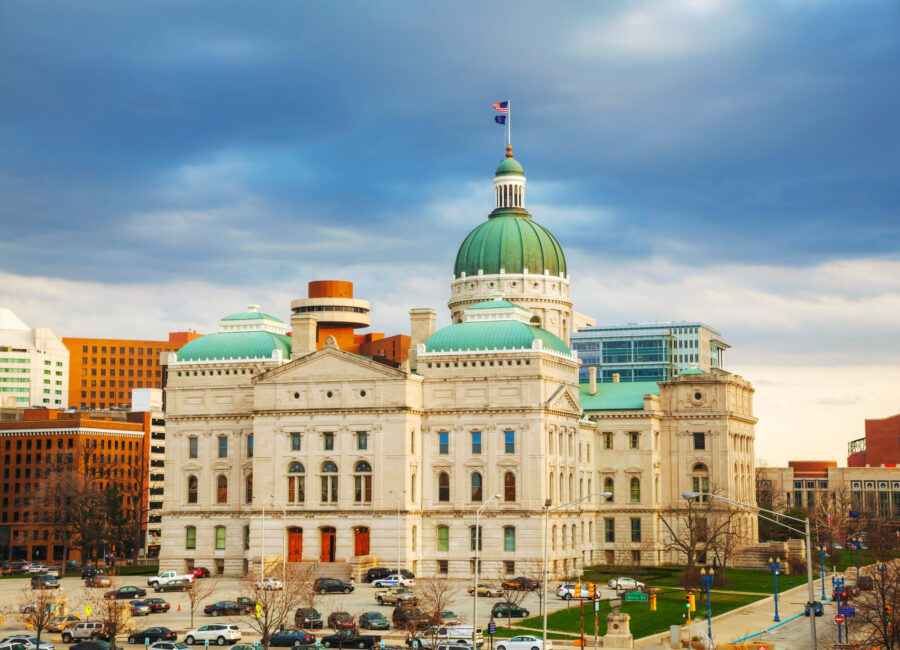
Indiana state capitol building in Indianapolis
2018 Legislative Priorities

A simple block with an image and text overlay.

Legislative Update: March Madness

Most restaurants had closed their kitchens by the time the General Assembly wrapped early Thursday morning – but with all the beef being served up at the Statehouse, it didn’t seem to matter.  The 2018 short session was just a little too short for several bills, triggering lots of frustrated comments and finger-pointing from lawmakers still trying to drag proposals across the finish line.

Retiring Senate President Pro Tem David Long got a going-away blast from House Republicans – accusing him of mismanaging the schedule over the last two days – and he didn’t hesitate to fire back as post-session press conferences looked more like a scene from 8 Mile (albeit with less rhyming).

The chaos crashed the autonomous vehicle bill (HB1341) among others. Governor Holcomb attempted an executive order to extend the session and salvage the leftover legislation, to no avail.  We’re glad no one suggested changing time zones to give themselves a couple more hours; the Governor may call a special session (likely timed with the scheduled technical correction day on May 15) to clean up the mess.

Pour out a little (Sunday-bought) liquor for the bills we lost:

Amid the jubilation over Sunday sales, we certainly suffered our share of disappointments this year. We’ll consider these temporary setbacks; bills may die but the issues they represent have plenty of life.

In fact, the first couple of bills below could have prevailed this year with an up-or-down vote.  Instead, they got sidetracked and hijacked to spare members from a public roll call on the floor.

Hard on Health

Legislation to raise the age to buy tobacco and the cigarette tax died, as lawmakers missed the big picture – a healthier workforce, higher productivity, lower public and private healthcare costs.   The bill (HB1380) passed the House Public Health Committee before being killed without a floor vote, with the short-sighted justification that fewer smokers mean lost cigarette tax revenues.

These proposals will be back, as we keep pushing the positive impact on business climate and workforce development to build enough support to blow away another procedural smokescreen.

Another health-related bill, SB232, would have addressed ‘food deserts’ by exploring ways to improve access to nutritious food options; it passed the Senate but didn’t get a House committee hearing.

Bias Crimes Buried

Like tobacco reform, bias crimes (SB418) never made it to a vote.  Hoosiers deserve better and want action: Polls show the public in favor of added penalties for hate crimes.  We’ll keep pushing for legislators to stand up against hate, and make Indiana a more open and inclusive environment for diverse talent – or at least have the guts to take a vote and explain it to their constituents.

Heavy-handed on Light Rail

HB1080 lifting the prohibition on Central Indiana light rail projects was killed by a poison bill amendment (as we detailed last week); the language made a brief reappearance in HB1374 but was stripped out at the last minute.   The original bill had strong momentum (passing the House 90-5 and making it through Senate committee), but regional transit options were derailed by a transparent political ploy.

Limiting Localism & Workforce Mobility

We weren’t thrilled that HB1278 passed, pushing stricter requirements for units creating economic improvement districts (EIDs).  These voluntary districts allow local employers to invest in specific priorities, as in Plainfield, where an EID funds transit routes serving the logistics businesses clustered there.

HB1278 sets the public hearing date for an EID for not more than 60 days after a mailed notice, and sets the approval vote at 60%; these limits were more onerous in the original bill, so at least the process moved the legislation in the right direction.

Flexible transit options and the use of EIDs for workforce mobility reflect the need to connect people and jobs; another bill helping people get to work was HB1152, which allowed Hoosiers with past traffic fines to keep their driving privileges to keep their jobs – it passed its first House committee test before dying in Ways & Means.

The bright side: Legislative ‘Wins’

Balancing these unfortunate outcomes, the Indy Chamber did advocate for a significant list of legislative advances – following are bills that passed and have been signed into law or await the Governor’s signature aligned with our ‘Open for Business’ Legislative Agenda.  Let’s start with the issue that will forever define the 2018 session:

Government Modernization

SB1 – SUNDAY CARRYOUT SALES — Enough said.  Drink up.

State and Local Economic Development: Entrepreneurship and Innovation Investments

SB257 – SALES TAX ON SOFTWARE – The Senate version sailed through the House and a unanimous Senate concurrence last week, avoiding this week’s last-day drama; with the stroke of a pen, Governor Holcomb will strengthen our high-tech business climate by exempting digital software sales from taxation.

HB1288 – ECONOMIC DEVELOPMENT – Among a broader set of provisions, we focused on this bill’s changes to the state’s Capital Access Program to support microlending programs (like the Chamber’s) for small and start-up business growth.

Transportation, Infrastructure, and Environment

SB386 – FINANCING OF FLOOD CONTROL IMPROVEMENTS – Authorizing flood control financing districts in Indianapolis to tackle much-needed projects along the White River is a big win for the city; the bill enjoyed broad support as it floated through both houses and was signed by the Governor Tuesday, checking off a key item on the Chamber Legislative Agenda.

Community Redevelopment and Investment

SB353 – STUDY OF REGIONAL DEVELOPMENT TAX CREDIT – Studies of a regional development tax credits, the inclusion of residential parcels in a property tax allocation area, and certified technology parks passed through the full Senate and House with unanimous support and is ready for Holcomb’s Hancock.

Workforce and Education

HB1001 – SCHOOL FUNDING – The conference committee report passed unanimously through both houses, authorizing transfers to fill school funding shortfalls in 2017 and 2018 of $25M and $75M respectively.

The ADM (enrollment) count for this funding is limited to five-year-old students (by August 1 of a school year).  This highlights the need for multiple enrollment counts for more accurate budgeting, along with expanded pre-K and a five-year-old enrollment requirement to ensure every child has early learning opportunities – HB1001 addresses the most severe fiscal symptom of a much broader set of issues.

HB1426 – EDUCATION MATTERS – The bill creates one Indiana Diploma with four designations (General, Core 40, Core 40 with academic honors, Core 40 with technical honors) and makes multiple changes to student assessment.

HB1420 — VARIOUS EDUCATION MATTERS — Most notably, allows alternative coursework to supplement or replace some existing requirements of a Core 40 diploma with academic honors.

HB1074 — VARIOUS HIGHER EDUCATION MATTERS — This bill allows for flexibility in the awarding of 21st Century Scholars program scholarships and expands eligibility requirements for workforce ready credit-bearing grants.  A single nay vote in the Senate kept the committee reports from unanimity.

SB387 — TEACHER PERMITS & SALARIES — Allows differentiated pay for special education teachers, those with science, technology, engineering, or mathematics expertise, and elementary school teachers with a master’s degree in math, reading, or literacy.

The next few bills are the core of the Chamber’s agenda to help ex-offenders rejoin the workforce, become productive taxpayers and contribute to economic growth instead of recidivism rates – a key issue within workforce development and inclusion:

HB1317 – HEALTH MATTERS – This bill was amended to revive language from SB11, allowing certain drug ex-offenders to receive federal SNAP benefits.

SB419 —PROFESSIONAL & OCCUPATIONAL LICENSES – This bill still preempts local licensure decisions in favor of State regulation – but a loss for home rule is a win for diverse talent, as it also allows Dreamers under the federal DACA program to pursue and be eligible to receive a professional or occupational license under state law.

HB1245 – OCCUPATIONAL LICENSING – Similar to SB419, HB1245 pre-empts local licensing authority; however, it does provide a great benefit for workforce reentry in its loosening of licensing restrictions for ex-offenders by mandating that governments must explicitly list the crimes that will disqualify an individual from receiving an occupational license, limits disqualification duration and sets up a petition process to requalify.

HB1007 — MENTAL HEALTH ACCESS —Includes language moved from SB224 that provides employer immunity from negligent hiring in situations where a prospective employee has a positive drug test but voluntarily enters treatment.

HB1047 — EDUCATION BENEFITS FOR VETERANS — This bill makes it easier for veterans to receive more robust financial aid for higher education by excluding certain veterans benefits from the determination of financial eligibility for need-based financial aid.

SB297 – EMPLOYABILITY SKILLS CURRICULUM – The bill charges the Department of Workforce Development with establishing interdisciplinary employability skills standards.  The final bill also brought back a new Work Ethic Certificate Program, which we’ll watch closely to promote consistency with our local Project Indy efforts.

SB172 – COMPUTER SCIENCE – Requires schools to offer computer science classes and creates the Next Level Computer Science Grant Program and Fund which funds teacher development programs in computer science.

HB1002 – WORKFORCE FUNDING AND PROGRAMS – Surprisingly kept separate from SB50 (the Senate workforce omnibus) the House bill requires an annual workforce review and report with the state budget, expands the eligibility criteria for workforce-ready credit bearing grants as well as establishes the “work Indiana program” (adult education grants) and a Next Level Jobs Employer Training Grant Program.  Its conference committee report stripped out creation of a Secretary of Workforce Training and workforce cabinet (included in SB50).

SB50 – WORKFORCE DEVELOPMENT; CAREER & TECHNICAL EDUCATION – The Senate’s workforce bill creates the Governor’s workforce cabinet, repealing and replacing the workforce innovation council.

Spring Training

The whittling down of these workforce bills as legislators defer major action until 2019 is typical of a short session.  Fiscal impact was a convenient excuse for scuttling some bills, but it’s true that most significant legislation is crafted in tandem with the biennial budget.

So even as the NCAA tournament gets underway, it’s baseball that provides the best metaphor – and epitaph – for this session: We took a few big swings and suffered a few strikeouts…but we also got our share of singles and doubles, bringing in some runs for our region.

But really, this legislature was like spring training, with next year’s budget-writing session looming as the big leagues. (Maybe that makes this year’s elections the draft?  And the work of our policy councils scouting reports?  Sports analogies aside, you’ll be hearing from your Business Advocacy team regularly in the meantime.)

Workforce and Education

Workforce

Employer-Driven, Sector-Specific Workforce Development:

GOAL: Build off of the recent work to better align state secondary education, workforce and economic development strategies that promote transferability, stackability, and permeability of credit awarding curricula. Also, we support state-based incentives to encourage businesses to employ students in an apprentice or intern capacity and provide on the job training with the final goal of permanently hiring those who have excelled

OUTCOME: The budget and policy changes in HB1002 doubles Next Level and Worforce-Ready grants for industry-driven training and creates non-profit Industry Credentialing Organizations to pursue financial and programmatic support to create credit, certificate and technical education opportunities for students

Veteran Re-entry:

GOAL: Increase employment opportunities for returning veterans by eliminating duplicative requirements and expedite processes for military-trained personnel to obtain the equivalent civilian license, as well as support ongoing efforts to recruit military personnel to the state to meet the workforce needs of regional employers

OUTCOME: HB1010 made income from military pensions exempt from state income taxes. SB491 provided funding for specialized treatment for traumatic brain injuries and eliminated co-pay requirement for related diagnostic testing.

Ex-Offender Re-entry:

GOAL: Support policies that promote reintegrating ex-offenders into the workforce and economy:

  • Minimize business liability and increase incentives to hire ex-offenders
  • Increase job training and skills enhancement opportunities
    • Expanding pre-release entrepreneurship education and training
    • Support funding for proven models for transitional employment and wrap-around services including access to housing and transportation

OUTCOME: HB1141 allows people to regain driving privileges with a traffic amnesty program, reducing fees and penalties by 50%.

Nurse Licensure Compact:

GOAL: Support licensing reciprocity between states to fill critical nursing shortages

OUTCOME: HB1344 allows for cross-state nurse licensure reciprocity with a $25 annual fee.

Higher Education

Next Level Jobs: 

GOAL: Support the Indiana Commission for Higher Education’s Return and Complete efforts to reengage Hoosiers with some college credit but no degree

OUTCOME: HB1001 doubles Workforce Ready and Next Level Employer grants to help adult Hoosiers upgrade their skills to match the demands of the job market;

21st Century Scholars:

GOAL: Enhance outreach and wraparound services and evaluate sustainable funding mechanisms for programs, such as the 21st Century Scholars program, in order to increase access to and completion rates at two- and four-year colleges and universities for those with financial need

OUTCOME: This program was fully funded.

Education

Superintendent of Public Instruction:

GOAL: Accelerate the appointment powers of the Governor to 2021

OUTCOME: HB1005 moved up the activation date to January 2021 (previous years legislation included an activation date of 2025)

STEM:

GOAL: Support dedicated funding and policies to deploy high-quality classroom science, technology, engineering and math (STEM) curricula and STEM-focused professional development for the educators.  Specifically, emphasize access to computer science and engineering courses at the high school level to prepare graduates for college and career opportunities in high-demand STEM fields. 

OUTCOME: To prepare students for higher-paying jobs, the budget also included funds for STEM programs, computer science teacher training and Industry Credentialing Organizations to support career and technical education partnerships.

High school Career Counselors:

GOAL:

  • Decrease the student-to-counselor ratio, require regular professional development for school counselors and ensure academic coursework align with students’ desired career pathways
  • Explore modification of counselor licensure to differentiate career counseling from social/emotional counseling
  • Require school counselors to advise students in middle school (6th, 7th and 8th grades) of their eligibility to enroll in various state financial aid programs

Also, provide school districts flexibility to pay teachers based on high need and specialized subject matter areas. Empower local education officials to make administrative and structural decisions affecting individual school performance, including the option to extend school hours, merit pay options, providing voluntary alternative retirement benefits options such as defined contribution plans for new teachers

OUTCOME: While the legislature largely left salary decisions to local districts, the budget did include $75 million for Teacher Appreciation Grants targeted specifically to bonuses and base pay for highly-effective teachers; budget provides teacher grants and teacher pay structure

Charter Authority:

GOAL: Expand the authority of the Mayor of Indianapolis to charter Pre-K educational institutions and require local public hearings for the re-chartering of schools attempting to switch charter authorizers after a charter has been revoked

OUTCOME: HB1641 gives school districts like IPS more flexibility on facility reuse by shortening the window for charters to pursue vacant school properties from 2 years (old law) to now 90 days under the state’s $1 law. The bill requires charters pursuing facilities over 200,000 square feet to demonstrate projected enrollment will be sufficient to utilize 60% of the facility’s capacity of the maximum student enrollment in the last 25 years of operation.

School Funding and Teacher Pay:

GOAL: Support efforts to increase teacher pay from the state to local school districts.

OUTCOME: The budget included $763 million in increased K-12 funding including $539 million in added tuition support (a 2.5% increase annually, just above inflation) and $150 million for advance payments to teacher pensions. The budget also included $75 million for Teacher Appreciation Grants targeted specifically to bonuses and base pay for highly-effective teachers.

Operational Efficiencies – HB1003 set school corporation efficiency targets and new financial reporting requirements aimed at minimizing administrative overhead and driving more dollars to the classroom.

Charter Funding – The budget provided $750 per-student support (a two-year total of $45 million in the Charter Innovation Grant Fund) and 85% of tuition support for virtual programs (down from the 90% status quo).

Complexity Funding – An early version of the budget all but flatlined complexity support, a move which would have been a hard hit to urban districts (like IPS) and rural schools alike, since both serve high numbers of students in poverty. The budget eventually found a middle ground on the complexity funding level ($3,650 for ’20, $3,675 in ’21) and urged an interim study committee on the most accurate way to count students in poverty.

Local Government and Fiscal Policy

Local Government Finance

Short-term Rental:

GOAL: Require short-term rental platforms to collect and remit local innkeepers’ tax; dedicate these dollars to accelerating, expanding and sustaining community strategies to combat homelessness and panhandling

OUTCOME: The online sales tax provisions formerly in SB322 were moved into the budget, levying innkeeper’s taxes on short-term rentals (and at ‘retail’ rates for online hotel booking sites) and requiring market facilitators like Amazon to collect state sales taxes.

Home Rule:

GOAL: Allow local government greater flexibility over their own structural and fiscal matters to address the needs of their individual communities

OUTCOME: Issues of regional cooperation and investment, local tax equity and state-local (county) revenue-sharing are on the interim study committee agenda.

Township Finances:

GOAL: Require township funds that exceed 150% of operating expenses to be spent on infrastructure projects within the township or credited to the taxpayer

OUTCOME: HB1177 required townships to prepare a three-year capital improvement plan that outlines a three year budget, cannot collect more property taxes without a balanced budget and capital plan.

Economic Growth

State and Local Economic Development

Convention, Sports and Tourism:

GOAL: Continue the momentum of Indianapolis’ convention and sporting industries by expanding current funding mechanisms. Leverage these resources to support expansion of the convention hotel footprint and prioritize existing facility investments. Provide for the sustainable operations of the Indianapolis Capital Improvement Board and support existing franchises, including the development of professional soccer

OUTCOME: SB7 expanded the downtown professional sports development area (PSDA), and extended the life of various Capital Improvement Board revenue streams to enable the continued investment in the decades-long public-private convention and sporting strategy. The bill allows for significant improvements to aging facilities, ensures a long-term lease agreement with the Pacers, and enables the development of Eleven Park and the growth of the world’s most popular sport in Indianapolis.

HB1115 (Tourism Development) also creates a statewide agency similar to Visit Indy to bolster Indiana’s tourism strategy.

Tax Increment Financing:

GOAL: Maximize the ability of local government units to respond to redevelopment and economic development opportunities through utilization of Tax Increment Financing (TIF) districts

OUTCOME: SB566 creates a new type of residential TIF, a tool for redevelopment commissions to encourage residential housing development (improvements in the bill allow the TIF to be applied equally to meet workforce housing demand in rural and urban areas alike). Various efforts to restrict TIF funding for much-needed workforce development investments were unsuccessful.

Certified Tech Parks:

GOAL: Increase the Certified Technology Park (CTP) tax capture allowance from the current $5 million cap to allow high performing CTPs to increase public-private investment in the CTP and surrounding areas

OUTCOME: SB563 allows longer renewal periods and flexible funding for Certified Tech Parks and allowed CTPs to capture an additional $100,000 annually to continue investment and operations in high-performing CTPs.

Entrepreneurship and Innovation Investments: 

GOAL: Support policies that can improve the State’s capital environment and nurture innovative activity through:

  • Maintain permanence of the state’s Research and Development, Hoosier Business Investment, and Venture Capital Investment tax credit programs.
  • Increase funding for the 21st Century Research and Technology Fund to support industry driven initiatives.
  • Maximize immediate value of state EDGE and VCI tax credit by allowing recipients to transfer credits for cash value
  • Enhancing flexibility for public investment in venture capital funds that invest in Indiana companies
  • Enhancing funding to support more university-sponsored grant programs and seed funding for applied research and commercialization

OUTCOME: SB563 establishes small business innovation vouchers to increase access to R&D resources and technical assistance programs offered by state universities or other research institutions.  It also updates qualified investments (under the Hoosier Business Investment tax credit) to include digital manufacturing equipment, and also extends the credit to apply against state retail and sales taxes.

The bill also expands the headquarters relocation tax credit so high-potential, venture-backed firms qualify and creates a new redevelopment tax credit, to encourage new investment in underutilized properties.  

Along with new tax breaks for large data centers (HB1405) and funding of the 21st Century Research & Technology Fund, the budget provided funding for the Business Promotion & Innovation Fund ($15.5 and $17 million in 2020 and ‘21), to cover key regional projects and new economic development programs like better air service connectivity and development of a forth port on the Ohio River.

Advanced Telecommunications:

GOAL: Support efforts by telecommunications providers to transition their networks from old legacy technology to an advanced all-IP, all-mobile and all-cloud infrastructure

OUTCOME: SB460 and HB1001 creates and funds the Next Level Connections program to expand broadband internet deployment.


Community Redevelopment & Investment

Regional Cities Initiative:

GOAL: Promote regional cooperation and strategic quality of life investments through the IEDC’s Regional Cities Initiative (RCI):

  • Support the development of clear metrics to measure success or return on investment of the Regional Cities Initiative from application to project implementation and beyond
  • Increase funding for technical assistance and planning grants for regional development authorities
  • Encourage the creation of federally recognized Economic Development Districts
  • Support the creation of a Regional Development Tax Credit to expand investment in quality of life projects and the productive reuse of brownfield sites

OUTCOME: The Regional Cities Fund was eliminated in the budget, but funding for Regional Cities projects was provided in the Business Promotion & Innovation Fund. The new Redevelopment Tax Credit provides preferential weighting for sites requiring environmental remediation and brownfields over 50 acres designated as a qualified investment.

Historic Rehabilitation:

GOAL: Increase state funding and incentives to encourage redevelopment and investment in aging commercial, industrial and residential properties.

OUTCOME:  Allows for nonprofit to qualify for historic preservation and rehabilitation grants if the historic property will be used for the benefit of the organizations purpose.  Increases the maximum grant from 35% to 50% qualified expenditures, not to exceed the grant ceiling of $100,000. Qualified expenditures for the history property has been reduced to $5,000 from $10,000.

In addition, HB1405 created a new food hall and alcohol permit, which is an important component of the redevelopment of the historic Coca-Cola bottling plant/IPS bus facility into the new Bottleworks District.

Shovel Ready Redevelopment:

GOAL: Support shovel ready community redevelopment efforts through the creation of a statewide grant program to fund the demolition of blighted commercial properties

OUTCOME: The redevelopment tax credit (SB563) was adapted to provide more flexibility to sites where buildings deemed a threat to health or public safety were proactively demolished (the previous “DINO” credit only applied to facilities of a certain size and age).

Food Deserts:

GOAL: Support innovative efforts to increase access to healthy food options to improve the health of Indiana resident and workforce

OUTCOME: Various bills were filed addressing food deserts and insecurity, yet little action was taken despite the rising awareness of the impact to urban and rural areas alike. We will continue to advocate for innovative solutions to address this critical issue.


Transportation, Infrastructure & Environment

Hoosier State Line:

GOAL: Maintain state support to continue operations and enhance service of the Hoosier State Line to better facilitate connectivity and economic opportunity between Indianapolis and Chicago

OUTCOME: $3 million previously allocated to support the daily service of the Hoosier State Line between Indianapolis and Chicago was not included in any version of the new budget. Service between these regions will continue 3 days a week via the Cardinal Line.

Greenways:

GOAL: Support the creation of a statewide loan or grant fund to build out of greenways and bike lanes for local communities

OUTCOME: Another $650 million will continue Governor Holcomb’s ‘Next Level Connections’ fund, which includes local trail grants and other infrastructure initiatives.

Mass Transit:

GOAL: Restore a dedicated funding stream for the Public Mass Transportation Fund (PMTF) to account for increased participation and demand of transit agencies throughout the state  

OUTCOME: Legislators continued funding the Public Mass Transportation Fund at $45 million annually, and reallocated $185M to continue double-tracking upgrades to the South Shore commuter rail line in Northern Indiana (positive precedents if the Central Indiana light rail ban is ever lifted to allow future regional transit planning to evolve unfettered).

Shared & Personal Mobility: 

GOAL: Capitalize on rapid advances in personal mobility and transportation by making new mobility options safe and accessible for Hoosiers, and positioning Indiana as a center of innovation for mobility solutions:

OUTCOME: HB1362 provides requirements for a peer to peer (P2P) vehicle sharing program. (and pre-empts any local ordinance, resolution, policy, or rule to regulate peer to peer vehicle sharing).

HB1649 (Electric Foot Scooters) addresses one new form of alternate personal mobility; it defines an electric foot scooter as not a motor vehicle for purposes of certain motor vehicle laws, and provides that an electric foot scooter has all rights and duties that apply to a person operating a bicycle.

Water:

GOAL: Support the creation of a statewide coordinating body to ensure sustained economic opportunity through responsible management of water resources

OUTCOME: HB1406 creates the water infrastructure assistance fund (with $20M/year in the state budget) to provide local government resources to improve water infrastructure. SB4 further creates a storm water management task force to study issues related to storm water management systems.

Legislative Priorities Index

Click a year to review past and current legislative priorities.