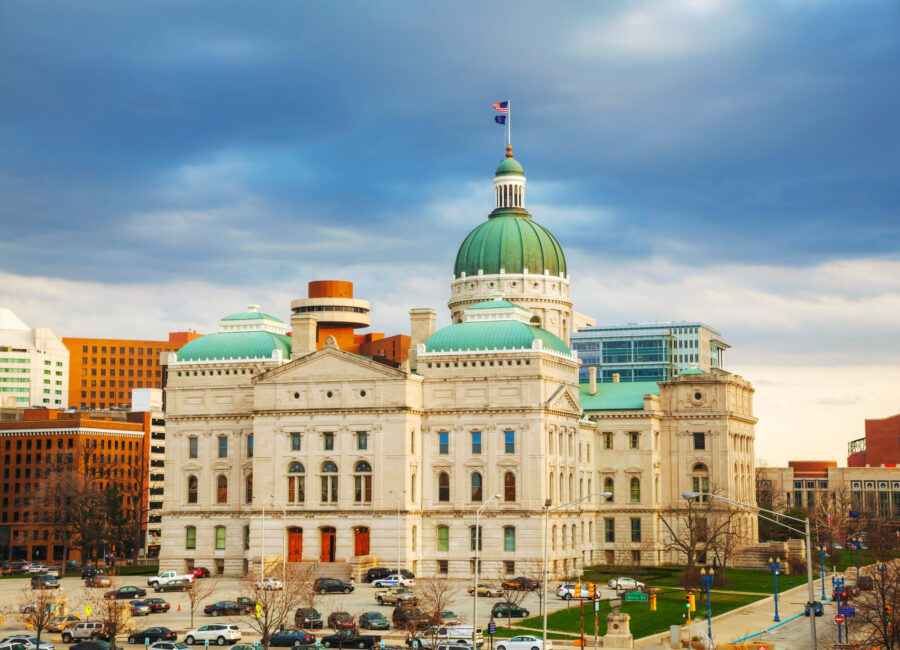
Indiana state capitol building in Indianapolis
2021 Legislative Priorities

A simple block with an image and text overlay.

2021 Priority Issues

ECONOMIC RESILIENCE

Build a more resilient, diversified Indiana economy that can withstand disruptions and prioritizes opportunity industries, workforce reskilling, and inclusive economic development   

  • Back to Work: Support safe return to work and economic recovery
    • Employer Liability Protections: Enact timely, temporary, and targeted employer liability protections for organizations in compliance with federal, state, and local COVID-19 guidelines and regulations
    • Work Share: Establish an Indiana Work Share program to save jobs, retain workforce skills, and maintain benefit coverage
    • Transit: Ensure workforce access to reliable public transit by holding harmless from funding cuts transit providers with low ridership due to COVID-19
    • Pregnancy Accommodations: Clarify employer guidance on reasonable accommodations for employees with medical conditions relating to pregnancy to improve maternal health and female workforce participation
  • Downtown Indy: Empower Indianapolis with tools to recover and rebuild
    • Panhandling: Existing statute should be amended to allow for proper enforcement of aggressive panhandling regulations in compliance with federal requirements
    • Service Enhancement: Support increased levels of service to homeless populations including a comprehensive approach to establish low-barrier shelters and wraparound service treatment models. Allow funds from Medicaid 1115 waiver to be used for homelessness intervention and prevention services
    • Reduction of Emergency Services Utilization: Develop and scale partnerships between law enforcement and human service providers to promote preventative care, reduce costly over-use of emergency services, and increase connection to treatment and wrap-around services
    • Economic Improvement District: Catalyze economic recovery and sustained investments in safety, cleanliness, and human services by reversing 2018 changes to the EID statute and increasing flexibility for downtown Indianapolis
  • Economic & Workforce Development Alignment: Prioritize Opportunity Industry growth
    • ReskillingLeverage federal funding to expand digital literacy and online instruction programs for adult learners. Prioritize programs preparing essential and displaced workers for career advancement in Opportunity Industries
    • Reshoring: Identify Opportunity Industries for potential reshoring and target with public incentives to attract relocating firms
    • Credentialing: Indiana workforce development system must adopt public funding criteria to assure the quality of online non-degree credentials; expand high-quality, short-term training to respond to market changes; prioritize sector partnerships for new programs to reskill displaced workers; target reshoring industries for new credentialing programs
  • Housing: Build financial stability, improved health outcomes, and housing market strength
  • Development Incentives: Establish a state-level tax credit to match or enhance federal LIHTC credits to incentivize development of new or rehabbed affordable units
  • Education: Protect early learning access, improve connectivity, and support school safety
    • Pre-K: Prioritize available federal relief funds to high quality childcare options; consider Adverse Childhood Experience scores in funding allocation; establish a Childcare tax credit; expand access to On My Way Pre-K by raising income eligibility
    • Digital Divide: Maximize equitable access to devices and connectivity (including innovative approaches from outside traditional telecom), prioritizing rural areas and communities of color to prevent widening of the achievement gap

Hold Harmless: Ensure school safety and uninterrupted instruction by holding harmless from funding cuts all schools forced into virtual learning by COVID-19

HOOSIER HEALTH

Support a comprehensive approach to increase the health, resiliency, and productivity of Indiana’s current and future workforce

  • Tobacco Tax: Raise Indiana’s cigarette tax by two dollars per pack and impose tax parity at point-of-sale for e-cigarette and vaping products
    • System Supports: Direct revenue from tobacco tax increases to raise Indiana’s low public health spend and address chronic public health challenges
  • Healthcare Workforce: Enhance workforce pipelines and supports for essential healthcare workers, public health system workforce, and mental health providers
  • Telehealth: Support the expansion of affordable telehealth options to improve access to care and enable more preventative care
  • Racial Health Disparities: Disaggregate government data to enhance equitable decision-making related to racial health disparities and social determinants of health
  • Food Access: Support agency flexibility to enable SNAP benefit utilization for online ordering and home delivery on a permanent basis
  • Mental Healthcare Funding: Explore strategies to enhance funding for wraparound services, reimbursement of mental health providers, and public safety partnerships

SMART JUSTICE REFORMS

Support strategic criminal justice reform to enhance public safety, maximize rehabilitation, and minimize jail overcrowding, recidivism, and local fiscal impact

  • Mental Health System: Support rehabilitative outcomes for mental health cases
    • Assessment & Diversions: Increase resources to court system to conduct mental health assessments and refer defendants to treatment and services
    • Pre-release Screenings: Administer mental health and skills assessments to inmates pre-release, connect to treatment, services, and employment opportunities
  • Administrative Reforms:
    • Multiple Felony Sentencing: To reduce impact on criminal justice systems, offenders with multiple felonies should be sentenced to the Department of Correction
    • Bail Consideration: Cash bond consideration must require a screening assessment and the ability to increase the bond considering severity of criminal history
    • Fines & Fees: Require that fines and fees not exceed cost to administer justice processes. Where fees exceed cost, surplus should fund restitution and treatment
  • Public Input and Oversight: Advance community trust and successful justice outcomes
    • Policymaking: Support Marion County efforts to establish structures for civilian input and oversight of law enforcement policymaking
    • External Oversight: Trigger automatic external investigation for fatal use of force or misconduct cases
  • Anti-Bias & Cultural Competency: Support community trust-building and deter bias
    • Training: Support law enforcement job performance by funding and requiring Cultural Competency, Implicit Bias, and Bias Crime training for all officers statewide
    • Bias Crimes: Amend bias crimes statute to make more inclusive and enforceable
  • Law Enforcement Officer Supports: Ensure officer well-being and accountability
    • Mental Health: Provide resources for mental health reviews and connection to services for law enforcement officers undergoing routine high stress
    • Pre-Employment Screening: Support candidate quality and officer job performance by requiring comprehensive background checks for Indiana law enforcement candidates, including group affiliation and and social media screens for racial bias
    • Body Cameras: Support statewide use of police body cameras and policies guiding the use, preservation, and public access to ensure transparency and accountability

Introduction

The past year has tested Central Indiana businesses as never before – struggling with the economic consequences of a global pandemic, shouldering the burden of operating safely for their employees and customers, and serving a community working to heal its divisions.

Racial Equity. Recovery. Resilience.

The Indy Chamber’s 2021 Legislative Agenda includes proposals for helping employers reopen safely, with the resiliency to succeed in the post-COVID recovery. Our agenda acknowledges that this recovery will be fueled by a skilled and diverse workforce, participating in a more equitable economy.

A more competitive business climate demands economic development and workforce programs supporting high-wage, advanced industry job growth, and investments in transit and housing incentives for the employees seeking these opportunities. It requires regional cooperation that recognizes the unique challenges faced by Indiana’s largest business district – downtown Indianapolis.

The COVID pandemic has also elevated public health as a policy priority, as the virus exploits many of the same chronic ailments and health conditions that have undermined Indiana’s workforce participation and productivity for decades. Raising the state cigarette tax to invest in the health of Hoosiers is an overdue response to an urgent concern.

Public health outcomes also reflect racial disparities, as systemic bias shortens lifespans as it limits economic mobility. This Legislative Agenda continues our emphasis on economic inclusion, with a more deliberate focus on racial equity. Inclusion must also be part of any blueprint for reducing crime; rebuilding trust between law enforcement and the neighborhoods it serves is crucial to our shared goal of a safer city.

Smart justice reform focuses on root cause issues like mental health, public oversight and transparency to increase community support for police, recognizing the challenges law enforcement face every day. Common-sense changes to bail and other administrative policies also serve our ultimate goal – enhancing public safety, not increasing number of Hoosiers in the system.

2020 has been a year of hardship for too many people and employers across the Indianapolis region, and the Statehouse won’t be the only source of solutions. But state policy must include long-term investments – starting in preschool and K-12 classrooms – that keeps Indy competitive and vibrant, the engine of Indiana’s economy and its tax base.

That’s why the Indy Chamber’s 2021 Legislative Agenda is an ambitious mix of prescriptions for managing the COVID crisis while looking beyond the pandemic – towards a more resilient, inclusive economy, ready to rebound into shared prosperity.

Dennis Murphy
President & CEO, IU Health
2020-2021 Chair – Board of Directors, Indy Chamber

Michael Huber
President & CEO
Indy Chamber

Smart Justice Reforms

Support strategic criminal justice reform to enhance public safety, maximize rehabilitation, and minimize jail overcrowding, recidivism, and local fiscal impact:

  • Mental Health System: Support rehabilitative outcomes for mental health cases
    • Assessment & Diversions: Increase resources to court system to conduct mental health assessments and refer defendants to treatment and services
    • Pre-release Screenings: Administer mental health and skills assessments to inmates pre-release, connect to treatment, services, and employment opportunities
  • Administrative Reforms:
    • Multiple Felony Sentencing: To reduce impact on criminal justice systems, offenders with multiple felonies should be sentenced to the Department of Correction
    • Bail Consideration: Cash bond consideration must require a screening assessment and the ability to increase the bond considering severity of criminal history
    • Fines & Fees: Require that fines and fees not exceed cost to administer justice processes. Where fees exceed cost, surplus should fund restitution and treatment
  • Public Input and Oversight: Advance community trust and successful justice outcomes
    • Policymaking: Support Marion County efforts to establish structures for civilian input and oversight of law enforcement policymaking
    • External Oversight: Trigger automatic external investigation for fatal use of force or misconduct cases
  • Anti-Bias & Cultural Competency: Support community trust-building and deter bias
    • Training: Support law enforcement job performance by funding and requiring Cultural Competency, Implicit Bias, and Bias Crime training for all officers statewide
    • Bias Crimes: Amend bias crimes statute to make more inclusive and enforceable
  • Law Enforcement Officer Supports: Ensure officer well-being and accountability, building on the bipartisan breakthrough in police reform embodied by House Bill 1006 in 2021 (and monitoring the implementation of its key provisions)

Education & Workforce

Workforce

Veterans in the Workforce: Increase employment opportunities for returning veterans by eliminating duplicative requirements and expedite processes for military-trained personnel to obtain the equivalent civilian license

Support ongoing efforts to recruit military personnel to the state to meet the workforce needs of regional employers

Re-entry from the Criminal Justice System: Support policies that promote reintegrating those formerly involved in the criminal justice system back into the workforce as productive contributors to our economy by:

  • Minimizing business liability and increasing incentives to hire ex-offenders
  • Increasing job training and skills enhancement opportunities
    • Expanding pre-release entrepreneurship education and training
    • Support funding for proven models for transitional employment and wrap-around services including access to housing and transportation

Social Determinants of Health: Increase strategic investments in public health, prevention, and social determinants to support talent-based economic development. Continue data collection efforts by the state on social determinants of health and unmet needs of government benefit recipients

Higher Education

Reverse Credit: Support permitting specific course credit to be transferable and reciprocal between Indiana’s accredited two-year schools and other state-supported colleges and universities to encourage post-secondary certification and degree attainment statewide

21st Century Scholars: Enhance outreach and wraparound services and evaluate sustainable funding mechanisms for programs, such as the 21st Century Scholars program, in order to increase access to and completion rates at two- and four-year colleges and universities for those with financial need

Education

Teacher Training: Work with school system leaders to require and fund all teachers in the state of Indiana to complete cultural competency and implicit bias training, without creating additional burdens or unfunded mandates

Achievement Gap & Disciplinary Policies: Support comprehensive, ongoing review of racial achievement gap and disciplinary policies resulting in inequitable outcomes

Early Childhood Education: Ensure children entering primary (K-12) education are academically, socially and emotionally prepared for success through high-quality, publicly-funded Pre-K programs; increased public investments should focus on those in financial need and support statewide access, while protecting funding and service levels in high-demand, high-capacity ‘pilot’ counties. Further, enact mandatory, fully-funded, full-day kindergarten by age 5 to create a consistent, quality early education pathway

School Safety & Mental Health: Allow public school funding for school resource officers and school safety referenda funding to be used to hire mental health program staff

STEM: Support dedicated funding and policies to deploy high-quality classroom science, technology, engineering and math (STEM) curricula and STEM-focused professional development for the educators. Specifically, emphasize access to computer science and engineering courses at the K-12 level to prepare graduates for college and career opportunities in high-demand STEM fields

Explore the creation of incentives to retain recent STEM-degreed individuals committed to remaining in-state for five years, with an emphasis on those graduates who enter the teaching profession.

High school Career Counselors:

  • Decrease the student-to-counselor ratio, require regular professional development for school counselors and ensure academic coursework align with students’ desired career pathways
  • Explore modification of counselor licensure to differentiate career counseling from social/emotional counseling
  • Require school counselors to advise students in middle school (6th, 7th and 8th grades) of their eligibility to enroll in various state financial aid programs

Required FAFSA Completion: Support matriculation to post-secondary educational institutions by making FAFSA completion or affirmative opt-out a requirement of high school graduation

Autonomy: Provide school districts flexibility to pay teachers based on high need and specialized subject matter areas. Empower local education officials to make administrative and structural decisions affecting individual school performance, including the option to extend school hours, merit pay options, providing voluntary alternative retirement benefits options such as defined contribution plans for new teachers

Operational Efficiency & Facilities: Support school corporations’ operational efficiency efforts by creating a 5-year, renewable exemption to the “Dollar Law” for school corporations that meet the following criteria:

  • Proven willingness and ability to partner with charter schools as demonstrated by:
    • 20% of school corporation’s student population attending innovation network school or innovation network charter schools
    • Equitable distribution of district operating referendum dollars to all innovation network schools, both in-LEA innovation network schools and out-of-LEA innovation network charter schools
  • Proven overcapacity of facilities within the district as demonstrated by independent analysis and verification
  • Commitment to address operational efficiencies as demonstrated by:
    • Undergoing strategic facilities optimization study on current and future population/enrollment projections
    • Implementation of strategic operational efficiency plans through strategic disposition of the properties previously subject to the dollar law

School Funding:

  • Carefully consider how changes to the local property tax base (e.g. further exemption or restructuring of the personal property tax) impacts school funding and referendum revenues
  • ADM Counts: Protect per-student funding from the lingering effects of COVID and remote learning by ensuring virtual instruction is fully-funded in the September ADM count; explore other ways to protect school funding from enrollment fluctuations as Indiana recovers from the pandemic
  • Complexity Index: While the Complexity Index received a modest $100 per student increase in the FY2022-2023 funding formula, aid to students in poverty continues to fall further behind the foundation grant per student, to the detriment of at-risk students and high-poverty districts:
    • Capture an accurate reflection of complexity by considering population of students with histories of trauma (measured by ACE scores), English as Second Language students, and those with developmental difficulties
    • Eliminate racial gaps in per pupil funding allocation, and address the findings of the 2020 report on Indiana school funding commissioned by Richard M. Fairbanks Foundation
    • Study these and other issues related to the challenges beyond the classroom faced by students living in poverty before the 2023 budget session, to advance the complexity conversation before the hectic pace of budget negotiations limits full consideration

Charter Authority: Expand the authority of the Mayor of Indianapolis to charter Pre-K educational institutions and require local public hearings for the re-chartering of schools attempting to switch charter authorizers after a charter has been revoked

Financial Literacy: Promote financial literacy education through existing k-12 curriculum requirements and encourage the DOE to develop sample curriculum for local schools to implement

Hoosier Health:

Education and workforce investments are maximized through a population that is healthy and productive on the job, ready to put their skills to use. The Indy Chamber supports a comprehensive approach to increase the health, resiliency, and productivity of Indiana’s current and future workforce.

  • Tobacco Tax: Indiana’s revenue outlook of strong, but raising the state cigarette tax isn’t a question of fiscal health, but public health: Raise Indiana’s cigarette tax by two dollars per pack, and align the new tax on e-liquids for tax parity at point-of-sale for e-cigarette and vaping products
    • System Supports: Direct revenue from tobacco tax increases to raise Indiana’s low public health spend and address chronic public health challenges
  • Healthcare Workforce: Enhance workforce pipelines and supports for essential healthcare workers, public health system workforce, and mental health providers
  • Telehealth: Continue to support the expansion of affordable telehealth options to improve access to care and enable more preventative care
  • Racial Health Disparities: Disaggregate government data to enhance equitable decision-making related to racial health disparities and social determinants of health
  • Food Access: Support agency flexibility to enable SNAP benefit utilization for online ordering and home delivery on a permanent basis
  • Mental Healthcare Funding: Explore strategies to enhance funding for wraparound services, reimbursement of mental health providers, and public safety partnerships, learning from best practices gleaned from the state’s investment in mental health grants in the current budget cycle

Legislative Priorities Index

Click a year to review past and current legislative priorities.