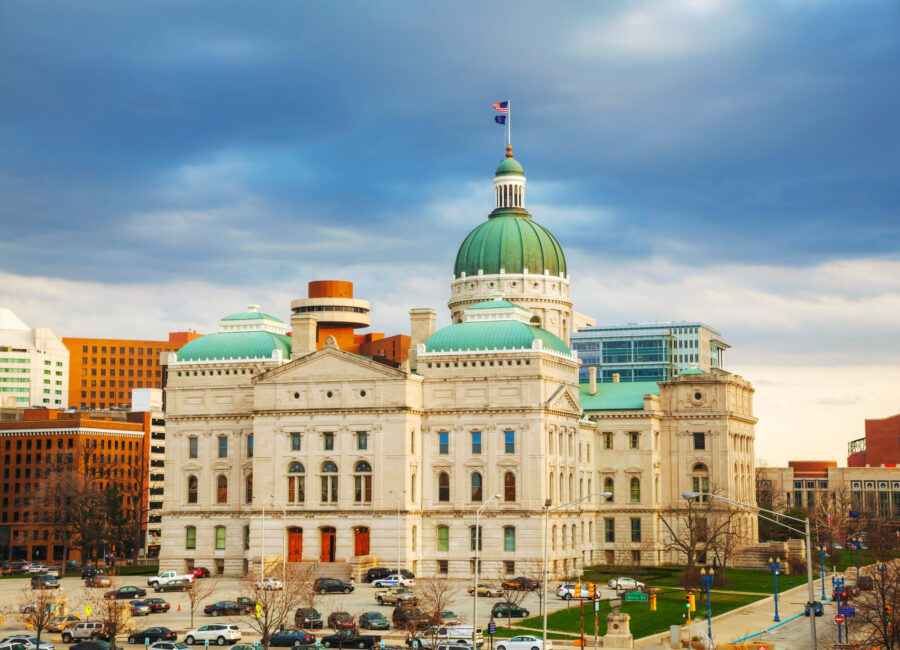
Indiana state capitol building in Indianapolis
2023 Legislative Priorities

A simple block with an image and text overlay.

Bridge the Talent Opportunity Gap

KEY CHALLENGES:

  • Indiana’s labor market is historically tight, with over 18k unique jobs open in the Indy Region alone. 
  • Postsecondary enrollment dropped 12% from 2015-2020, falling 10% below the national average (Black students decreased from 50% to 43% between 2019-2020; Hispanic/Latino decreased from 49% to 44%). 
  • In two-thirds of Indiana counties, less than half of children 0-5 have access to high-quality, reliable, and affordable early education.

RAISE POST-SECONDARY ATTAINMENT:

Automatically enroll eligible students in the 21st Century Scholars Program to increase higher education enrollment, particularly for low-income students and students of color. 

  • 40% of high school graduates are eligible for 21st Century Scholars, but less than half of eligible students enroll. Automatic enrollment would deliver resources to a greater number of eligible students—the state already budgets for the full eligible population. 
  • 21st Scholars are nearly three times more likely to attend college than their low-income peers. Across all demographic groups, 21st Scholars are as or more likely to complete college than their higher-income peers. 
  • Increase Complexity Index to ensure adequate support to maintain current scholar program requirements, increased FAFSA completion, sufficient counseling resources, and wraparound services for increased student enrollment.

EARLY EDUCATION

Expand access to and affordability of high-quality, early education and childcare to support parental labor force participation:

  • Increase the eligibility threshold to allow more Hoosier families to access high-quality early education. 
  • Align state investment to expand access and accommodate market rate increases (wage inflation). 
  • Support streamlined regulations on early education providers and explore other solutions to address workforce shortages (e.g., direct surplus stimulus dollars to tuition forgiveness, and employee benefits).

Advance the Vitality of Downtown

KEY CHALLENGES:

  • The reality and perception of public safety downtown remain critical to Indianapolis’ competitiveness as a place to live, work, and visit. 
  • Mechanisms are required to promote sustained funding to maintain a clean, accessible, and beautiful downtown. 
  • Downtown Indianapolis requires transformational investments to catalyze business opportunities, develop attainable housing (at all income levels), and enhance transportation connectivity.

COMPETITIVE LIVABILITY:

Prioritize comprehensive solutions and investments to make Indianapolis the most livable downtown in the United States. 

  • Sustain strategies that improve public safety in the Mile Square for residents, visitors, business owners, and those experiencing homelessness. 
  • Support organizations and solutions aiming to enhance resources dedicated to maintaining the cleanliness of public spaces and right of way in the Mile Square. 
  • Catalyze efforts to enhance Indianapolis’ livability, such as innovative strategies for attainable housing development and redesign of key transportation infrastructure like the Indianapolis Inner Loop.

Fund Indiana’s Roads

KEY CHALLENGES:

  • Increase road funding to support fast-growing metros throughout the state, while maintaining investment in rural communities.
  • Move toward non-fuel tax revenue sources for road construction and maintenance.
  • Solve road maintenance problems to allow state and local governments to invest in transformational transportation and infrastructure projects—first take care of what we have, then finish what we started, then build for the future.

DISTRIBUTION STRATEGY:

Increase road funding support for fast-growing metros and maintain investment in rural communities by:

  • Under the Motor Vehicle Highway-Local Road Streets account, move towards a user fee system to distribute mileage-based dollars to local communities.
  • Direct new dollars invested in the funding formula to the Highway Road & Street Fund.
  • Raise the Community Crossings grant cap to allow larger communities to leverage more state dollars, remove requirement for 50% of allocation to rural.
  • Retire debt obligations, while maintaining current revenue streams, to release additional annual funding—direct to Highway Road & Street Fund.

NEW REVENUE CONCEPTS:

Move state toward non-fuel tax revenues for road construction and maintenance by:

  • Consider moderate increases to non-fuel revenue sources:
    • Hybrid/Electric Vehicle registration fee.
    • State-wide vehicle excise tax.
  • Explore strategic implementation tolling in high-travel areas around the state.
    • Consider Borman Expressway, I-70, I-74, and I-65.
    • Consider tolling of High Occupancy Vehicles and/or express lanes.
  • Pilot milage-based user fee.
    • Ohio, Missouri, Texas, and others have pilots.

Introduction

Welcome to the Indy Chamber’s 2023 Legislative Agenda, a comprehensive resource that outlines our efforts to unite the Indy Region, tell the Indy story, and grow an equitable economy. In 2022, our agenda was themed, Ready to Rise with a strong focus on the pandemic response and racial equity. 2023 promises to build on those priorities with a focus on regional competitiveness.

Accelerating Competitiveness

In 2022, the Indy Chamber launched the second phase of Accelerate Indy—an economic development strategy to position the Indy Region as the premier destination for talent and opportunity for all. Support from our regional business community has played a critical role in funding this strategy and implementing this work—work that will help our region surpass our national, peer markets, including Denver, Nashville, Charlotte, and Columbus.


Central Indiana continues to drive economic growth for the Hoosier state’s economy. Over the past five years, the Indy Region has established itself as a top market in the Midwest. However, the region and the state still face barriers to realizing their full economic potential—barriers that will take collaboration to overcome. The business community and state legislature must find common ground on solutions to address talent attraction and retention, national image perception, quality of place, and business environment.


When it comes to talent, Indiana is primed for investments in its people. With a historically tight labor market and evidence of drastic declines in college enrollment, we are calling for an evaluation of how to accelerate the 21st Century Scholars Program—an offering that makes students three times more likely to attend college and more likely to complete it.


In addition, chronically poor health outcomes remain a critical challenge to our state’s quality of life and economic competitiveness. Bringing our state investment in public health services and preventative healthcare to levels competitive with the national average is an imperative we cannot afford to defer.
The epicenter of our state sets the tone for national perception, and solutions are needed for Downtown Indianapolis. To compete as the most livable downtown in America, sustainable resources are required to support safety, cleanliness, and planning for a post-pandemic, transformational future of downtown.
Finally, we must confront a key contributor to quality of place: Indiana’s roads. Fast-growing metropolitan communities around the state are severely disadvantaged by the current state road funding formula. Changes to adequately support infrastructure maintenance in metros, while keeping rural communities whole, are essential. The state also must consider long-term strategies to replace declining, fuel-based support for roads as the adoption of electric vehicles accelerates.


Indiana is poised to make transformational investments in the fundamentals of its economic competitiveness: talent, image, business, and place. The Central Indiana business community is ready to partner with the General Assembly to forge solutions and accelerate our state’s competitiveness to continue to compete on the national and global stage.


Melissa Proffitt
Partner-in-Charge of Client Relations, Ice Miller
2022-2023 Chair – Board of Directors, Indy Chamber

Legislative Priorities Index

Click a year to review past and current legislative priorities.