
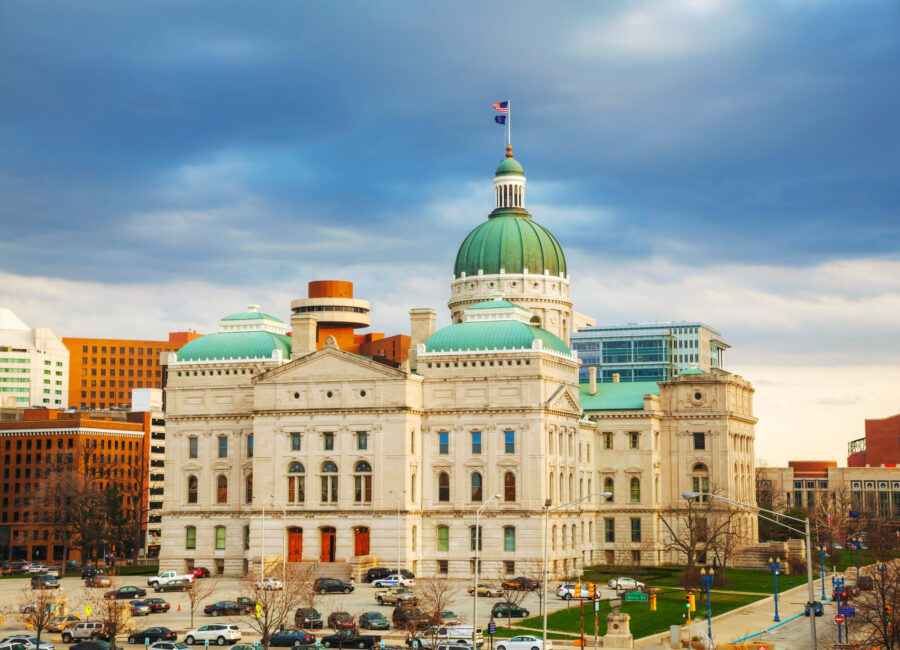
Indiana state capitol building in Indianapolis
2024 Legislative Priorities

A simple block with an image and text overlay.

Talent

Enhance the state’s education and workforce pipelines by supporting private sector efforts to expand apprenticeship and work-based learning. Simultaneously, continue to remove barriers to postsecondary enrollment by allowing undocumented students to qualify for residential tuition at Indiana state-supported universities.

APPRENTICESHIPS AND WORK-BASED LEARNING:

  • Indiana legislative and executive leadership must continue to partner with private sector efforts to expand apprenticeships and work-based learning across the state.
  • Clarify that the use of the state’s Career Scholarship Accounts (enabled under HEA1002- 2023) for eligible work-based learning experiences counts towards high school graduation requirements and ensure that students who participate in the Modern Apprenticeship Program, and similarly qualified apprenticeship models, earn credit that can be translated to post-secondary education.
  • Provide authority to employers to define occupational standards and provide the authority for those to be incorporated into professional and academic education.
  • Enact targeted employer liability protections to support high school juniors’ and seniors’ participation in on-site apprenticeships.
  • Enable flexibility for high schools to participate in youth apprenticeship programs, including ensuring students participating in the Modern Apprenticeship Program are counted toward a school’s average daily membership (ADM) count and are supported in their participation through transportation, scheduling, childcare, or other needs.

RESIDENTIAL TUITION RATES:

  • Allow students who are domiciled in the State of Indiana, have attended an Indiana high school for at least three years, or have graduated from an Indiana high school to be eligible for the resident tuition rate at state educational institutions.

EARLY EDUCATION & CHILDCARE: Ensure Indiana’s attractiveness to prospective employers and top talent by enhancing the availability of affordable, high-quality childcare and early education.

  • Define early education and childcare as essential infrastructure for a 21st Century economy and critical to Indiana to take advantage of generational economic development opportunities, such as the CHIPS Act.
  • Streamline state regulations on early education, while maintaining quality and safety:
    • Establish minimum licensing standards and enhance talent attraction to the profession.
    • Enable provider micro-site creation and provider site sharing.
  • Support efforts to implement the tri-share childcare payment model.
  • Support other recommendations of the Interim Study Committee on Public Health, Mental Health, and Human Services.

Introduction

When it comes to core drivers of economic growth, the availability of highly skilled talent in an environment where it can thrive is the greatest predictor of an economy’s success. People are the engines that drive growth, innovation, and, ultimately, prosperity.

But whether people can participate in a growing economy depends on their access to education and work experiences that equip them with skills employers need. To remain competitive, Indiana must ensure greater access to, participation in, and completion of postsecondary education, including alternative pathways, such as modern youth apprenticeships. We must also retain more graduates and compete for new talent by investing in safe and vibrant communities people want to call home, whether they grew up in Indiana or become Hoosiers by choice.

Right now, Hoosier students face an uncertain future. Around 25 percent of Hoosier high school graduates complete a two- or four-year degree at an in-state, public postsecondary institution. For students of color, the rates are even lower, with only 11 percent of Black Hoosier students and 16 percent of Latino students completing college at public universities in the state.

The need for skilled talent is anticipated to rise, particularly with the advent of AI and continued automation. By 2027, 70 percent of jobs will require a postsecondary degree or credential. Proactive solutions are needed to create more accessible pathways that directly align with employers’ needs and are resilient to leadership turnover. This necessitates broad collaboration across education, business, and government.

While a high school diploma is no longer sufficient to provide the skills needed for most to succeed in our modern economy, a traditional college degree is not the only path to success. It is imperative to construct alternative pathways to high-skill, high-wage career opportunities, such as modern youth apprenticeships. Inspired by the Swiss model and studied at length by Hoosier leaders from education, business, government, and philanthropy, youth apprenticeship programs are being piloted across the state in diverse industries such as healthcare, advanced manufacturing, financial services, and technology.

The business community is eager to expand the reach of these programs. Legislative support is essential to ensure high school and postsecondary credit is offered for apprenticeship experience, to involve employers in performance evaluation and academic standard development, to develop appropriate safety and liability standards, and to maintain current levels of school funding by counting apprentices toward average daily matriculation. These policies are vital for expanding work-based pathways to high-skill opportunities for Hoosier students.

Alongside efforts to construct new, experiential pathways to high-skill, high-wage jobs, it remains critical to make traditional college degrees more accessible for Hoosier students. Automatic enrollment of eligible students into the 21st Century Scholars program in 2023 was a move in the right direction. The next step is to allow in-state tuition at Indiana public universities for eligible undocumented students—an important strategy to retain a diverse and fast-growing population that already calls Indiana home.

When it comes to investing in Hoosier communities as talent-magnets, there is no more important place to start than downtown Indianapolis. Downtown’s Economic Enhancement District (EED) – supported by the business community, authorized by the General Assembly, and enacted by the Indianapolis City-County Council in 2023 –  dedicates sustainable funding toward public safety, cleanliness, homelessness response, and economic growth in the Mile Square. These are important ingredients to a commercial and residential environment that attracts and protects property owners’ investments. Downtown belongs to all Hoosiers, and the EED will be critical to supporting its vibrancy for years to come.

The connection between cultivating a skilled workforce and fostering dynamic communities with robust economic development is inextricable and indispensable for Indiana’s long-term success. Central Indiana must establish a resilient and adaptable framework to meet the demands of a rapidly evolving economy. Legislative support, strong partnerships, and a shared commitment to Indiana’s future growth and competitiveness will be instrumental in achieving these goals.

Matt Mindrum
President & CEO, Indy Chamber

John Hirschman
President & CEO, Browning
Chair – Board of Directors, Indy Chamber

Workforce and Education

WORKFORCE

Employer-Driven, Sector-Specific Workforce Development: Build off of the recent work of the Indiana Career Council and the Indiana Regional Works Councils to better align state secondary education, workforce and economic development strategies to meet the current and future skills demands of regional employers

  • Employer-Sponsored Co-Ops: Supports state-based incentives to encourage businesses to employ students in an apprentice or intern capacity and provide on the job training with the final goal of permanently hiring those who have excelled

Work Opportunity Tax Credit:  Support Hoosiers entering the workforce through the creation of state tax incentive which mirrors the Federal Work Opportunity Tax Credit (FWOTC) program focused on ex-offenders and the long-term unemployed

  • Support incentives for government contractors who hire and retain individuals eligible for WOTC credit

Veteran Re-entry: Increase employment opportunities for returning veterans by eliminating duplicative requirements and expedite processes for military-trained personnel to obtain the equivalent civilian license

Ex-Offender Re-entry: Support policies that promote reintegrating ex-offenders into the workforce and economy by:

  • Minimize business liability and increase incentives to hire ex-offenders
  • Increase job training and skills enhancement opportunities
    • Expanding pre-release entrepreneurship education and training
  • Ensure local compliance of statewide compliance of recent expungement laws
  • Remove barriers related to housing & transportation

HIGHER EDUCATION

  • Career Pathways: Support the creation of college career pathways to ensure curriculum align with current and future skills demands and increase college completion
    • Encourage development of credit awarding workplace readiness courses to enhance experiential learning requirements for degree completion
  • Reverse Credit: Support permitting specific course credit to be transferable and reciprocal between Indiana’s accredited two-year schools and other state-supported colleges and universities to encourage post-secondary certification and degree attainment statewide
  • Return and Complete: Support the Indiana Commission for Higher Education’s Return and Complete efforts to reengage the 737,000 Hoosiers with some college credit but no degree
  • STEM: Explore the creation of incentives to retain recent STEM-degreed individuals committed to remaining in-state for five years
  • 21st Century Scholars: Enhance outreach and wraparound services and evaluate sustainable funding mechanisms for programs, such as the 21st Century Scholars program, in order to increase access to and completion rates at two- and four-year colleges and universities for those with financial need

Immigration Reform: Encourage federal leadership on comprehensive immigration reform. Restore eligibility for in-state tuition and financial aid to state colleges and universities for foreign born students who have matriculated through the Indiana K-12 system

EDUCATION

STEM: Support the continued work of the Indiana Department of Education to assess the qualitative and quantitative capacity of STEM instruction and empower a public body comprised of k-12 practitioners, higher education and workforce development professionals and private industry experts to implement the finding of the STEM assessment

  • Explore the creation of incentives to retain recent STEM-degreed individuals committed to remaining in-state for five years

High School Career Counselors:

  • Decrease the student-to-counselor ratio, require regular professional development for school counselors and ensure academic coursework align with students’ desired career pathways
  • Explore modification of counselor licensure to differentiate career counseling from social/emotional counseling
  • Require school counselors to advise students in middle school (6th, 7th and 8th grades) of their eligibility to enroll in various state financial aid programs

Autonomy: Provide school districts flexibility to pay teachers based on high need and specialized subject matter areas. Empower local education officials to make administrative and structural decisions affecting individual school performance, including the option to extend school hours, merit pay options, providing voluntary alternative retirement benefits options such as defined contribution plans for new teachers

Charter Authority: Expand the authority of the Mayor of Indianapolis to charter Pre-K educational institutions and require local public hearings for the re-chartering of schools attempting to switch charter authorizers after a charter has been revoked

Financial Literacy: Promote financial literacy education through existing k-12 curriculum requirements and encourage the DOE to develop sample curriculum for local schools to implement

School Funding: Support the inclusion of the second count date for the k-12 funding formula to ensure schools are able to adequately accommodate changing student populations throughout the school year

Local Government and Fiscal Policy

LOCAL GOVERNMENT FINANCE

Home Rule: Allow local government greater flexibility over their own structural and fiscal matters to address the needs of their individual communities

Township Finances: Require township funds that exceed 150% of operating expenses to be spent on infrastructure projects within the township or credited to the taxpayer

GOVERNMENT MODERNIZATION

UniGov: Seek greater efficiencies in municipal service delivery and finance in Marion County by building on the principles of unified government, including county-wide consolidation of fire departments

Redistricting Reform:  Support non-partisan redistricting reform that increases and encourages competition of ideas, decreases polarization in legislative and congressional districts, accurately reflects historic trends in statewide elections and maintains communities of interest and adheres to local political boundaries

Statewide: Continue efforts to streamline overlapping government functions through statewide implementation of recommendations made by the Indiana Commission on Local Government Reform to increase accountability, transparency and effectiveness of local governments

Government Innovation: Encourage state and local governments to create Offices of Innovation to drive policies that inspire open data, transparency, drive efficiencies that can result in greater economic activity and workforce development

Alcohol Code Revisions: Support a comprehensive evaluation and modernization of current alcohol laws and regulations, including Sunday Sales of retail carry-out alcohol and removing restrictions on manufacturers, distributors and retailers from producing, distributing or selling beer, wine and spirits

Legislative Priorities Index

Click a year to review past and current legislative priorities.