
Regional collaboration will advance Accelerate Indy 2030 talent priorities and strengthen pathways between workers, skills and quality jobs
INDIANAPOLIS. The Indy Chamber today announced a new regional workforce initiative supported by a $250,000 grant from Walmart to strengthen how Greater Indianapolis connects workers with skills, quality jobs and opportunities for career advancement. Led by the Indy Chamber in collaboration with CEOs of Indiana Corporate Partnership (CICP), Ascend Indiana, The Indianapolis Foundation, United Way of Central Indiana, EmployIndy, Goodwill of Central & Southern Indiana and other regional partners, the five-month planning effort will examine how existing workforce programs and partnerships can be better connected and scaled across the region.
The initiative directly supports the talent priorities of Accelerate Indy 2030, the region’s strategy for economic growth and competitiveness, including building stronger connections between employers, educators and workforce partners and ensuring residents can access pathways to high-opportunity careers.
“Greater Indianapolis has strong employers, workforce partners and training programs already doing important work across our region,” said Matt Mindrum, president and CEO of the Indy Chamber. “This grant gives us an opportunity to connect those strengths more intentionally and build clearer pathways between people, skills and quality jobs. We’re grateful to Walmart for supporting our efforts to create a workforce system that can respond to employers’ evolving needs while expanding economic opportunity for workers across our region.”
As employers and workers navigate a labor market increasingly shaped by artificial intelligence, new technologies and evolving skill needs, the initiative will focus on strengthening the systems already serving the region rather than creating another standalone workforce program. The planning process will include regional labor-market research, mapping of existing workforce assets and engagement with employers, educators and community partners.
Areas of exploration will include accelerated training tied to employer demand, employer-backed career mobility pathways, work-based learning and earn-and-learn opportunities, career navigation, and data and skills-based hiring tools. The work will place particular emphasis on adults seeking greater economic mobility, including incumbent and dislocated workers and others seeking pathways into higher-quality careers.
“Indiana’s economic competitiveness depends on our ability to connect people with the skills and opportunities needed in a rapidly changing economy,” said Melina Kennedy, Chief Executive Officer of CEOs of CICP. “Across Central Indiana, employers and workforce partners have already built strong foundations in many of our highest-opportunity industries. This grant gives us the chance to build on that momentum, better align talent with employer demand and create more accessible pathways for workers to advance into rewarding careers.”
By the conclusion of the planning period, the coalition expects to identify a focused set of high-impact strategies that can move toward implementation and produce measurable career mobility outcomes. The goal is to build on what Greater Indianapolis already does well while creating a more connected, responsive workforce system capable of meeting the changing needs of workers and employers.
Walmart and Walmart Foundation have provided more than $180 million in workforce development grants and initiatives since 2021. The Indianapolis investment is part of Walmart’s broader effort to help communities prepare workers and employers for the changing future of work.
About the Indy Chamber
The Indy Chamber serves as a regional voice for progress, uniting business and community to strengthen the Indy region’s economy and quality of life. Through bold advocacy, economic development, and small & mid-size business support, we help fuel growth, expand opportunity, and position the region to compete and thrive. Working alongside civic, corporate, and community partners, the Indy Chamber focuses on attracting investment, developing talent pathways, and elevating the Indy region’s story. Guided by our core values – Love Indy, Dream Big, and Move Together – we bring leaders together to shape the conditions for growth and build a future where the Indy region leads the Midwest and competes on a global stage.
Pyrz will lead the Chamber’s internal operations and organizational strategy
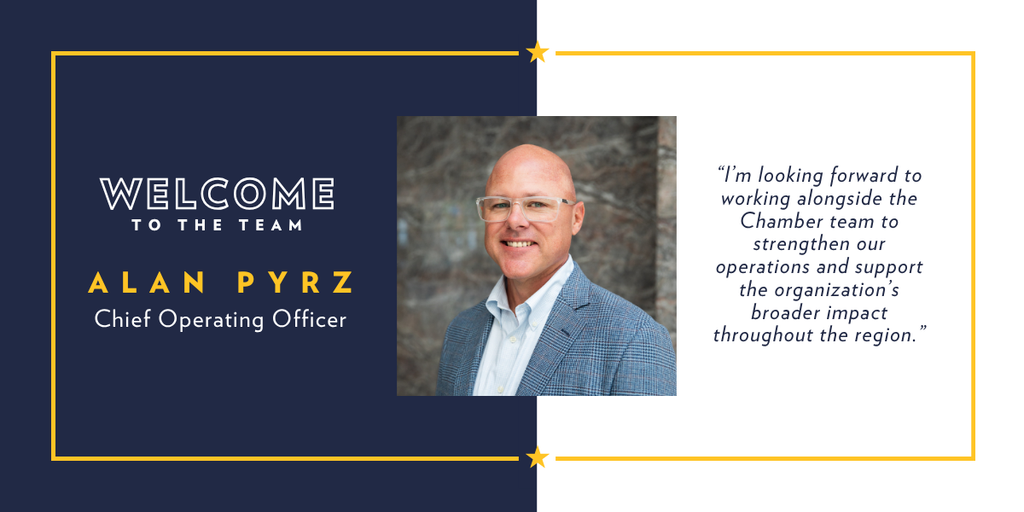
INDIANAPOLIS. The Indy Chamber has named Alan Pyrz as Chief Operating Officer, bringing nearly three decades of entrepreneurial, operational and technology leadership experience to the organization.
In his role, Pyrz will help lead the Chamber’s internal operations and organizational strategy, supporting the systems, processes and infrastructure that enable the organization to advance its work on behalf of businesses and communities across the Indianapolis region.
“Alan brings the rare combination of an entrepreneur’s perspective and an experienced operator’s discipline,” said Matt Mindrum, president and CEO of the Indy Chamber. “He understands firsthand what it takes to build and grow a business in Indianapolis, and he has spent his career helping organizations navigate the operational realities that come with growth and change. That experience will be incredibly valuable as we continue strengthening the Chamber and delivering on our mission across the region.”
Pyrz co-founded eGov Strategies, an Indianapolis-based government technology and payments company, and helped grow the business to serve more than 600 government and utility clients across 35 states. Following the company’s acquisition in 2020, he held several senior executive roles with responsibilities spanning operations, integration, technology strategy and organizational leadership.
Throughout his career, Pyrz has worked closely with cities, counties, utilities, financial institutions, technology partners and other organizations. His experience spans financial, legal, personnel, compliance and operational matters, complemented by a strong technical background in automation, security, technology and infrastructure.
“Having spent much of my career building and operating a business here in Indianapolis, I’m excited to bring that perspective to the Indy Chamber,” said Pyrz. “I’ve seen firsthand both the opportunities businesses have here and the practical challenges leaders navigate as their organizations grow. I’m looking forward to working alongside the Chamber team to strengthen our operations and support the organization’s broader impact throughout the region.”
Pyrz earned a Bachelor of Science in Civil Engineering from Purdue University and a Juris Doctor from Indiana University. He and his wife, Jennifer, have lived and worked in Indianapolis for the past 30 years and have three children.
About the Indy Chamber
The Indy Chamber serves as a regional voice for progress, uniting business and community to strengthen the Indy region’s economy and quality of life. Through bold advocacy, economic development, and small & mid-size business support, we help fuel growth, expand opportunity, and position the region to compete and thrive. Working alongside civic, corporate, and community partners, the Indy Chamber focuses on attracting investment, developing talent pathways, and elevating the Indy region’s story. Guided by our core values – Love Indy, Dream Big, and Move Together – we bring leaders together to shape the conditions for growth and build a future where the Indy region leads the Midwest and competes on a global stage.
For Immediate Release
Aug 31, 2026 at 6am
Indy Chamber Foundation Receives $2.25M Grant from Lilly Endowment to strengthen Life in Indy Initiative
The investment will refresh and scale the platform’s digital presence, talent attraction initiatives, and community storytelling
INDIANAPOLIS. Today the Indy Chamber Foundation announces the next chapter of its Life in Indy regional storytelling platform, powered by renewed support of $2.25 million in grant funding from Lilly Endowment Inc. Continuing an integral relationship catalyzed at Life in Indy’s launch in 2020, this grant marks a capacity-building investment in livability storytelling and talent growth in the Indy region.
Life in Indy provides information and stories about neighborhoods, schools, faith communities and spiritual life, museums and other cultural amenities, and major employers across the Indianapolis region. Its design and content are designed to appeal broadly across demographics, industries and age groups. Visitors to Life in Indy can use the platform to connect with local residents to learn directly about the Indy region.
With new funding from Lilly Endowment, this asset that is designed to help people discover and connect to the Indy region will modernize its approach to digital storytelling, deepen community connections with authentic storytellers to elevate the region’s profile, and expand its research capacity to identify opportunities for building positive perceptions of Indy across the country. Life in Indy is a significant part of Indy Chamber’s strategic goal of establishing the Indianapolis region as the top destination for talent in the Midwest by 2030.
“Life in Indy is a crucial engine for helping prospective residents discover the Indy Region and consider making it their home,” said Blaine Zimmerman, Chief Talent and Marketing Officer at the Indy Chamber. “This support from Lilly Endowment will help sustain the initiative’s work as we continue to build the infrastructure, partnerships, and methodology necessary to tell Indy’s story.”
Since Life in Indy launched in 2020, it has yielded results exceeding major project milestones. It has published more than 200 stories about Indy and receives more than 30,000 monthly visitors. More than 4,000 prospective residents have requested to connect with additional resources; and more than 650 employer partners used Life in Indy content in their recruitment and onboarding processes.
At a pivotal moment for the growth of the Indy region, Life in Indy continues to accelerate Indy’s story, told by the locals building it.
About Life in Indy
Life in Indy is a community-driven storytelling platform created to attract talent and highlight authentic experiences across the Indianapolis region. With articles, videos, and first-person narratives, Life in Indy celebrates the people, places, and stories that make Indy home.
About the Indy Chamber
The Indy Chamber serves as a regional voice for progress, uniting business and community to strengthen the Indy region’s economy and quality of life. Through bold advocacy, economic development, and small & mid-size business support, we help fuel growth, expand opportunity, and position the region to compete and thrive. Working alongside civic, corporate, and community partners, the Indy Chamber focuses on attracting investment, developing talent pathways, and elevating the Indy region’s story. Guided by our core values – Love Indy, Dream Big, and Move Together – we bring leaders together to shape the conditions for growth and build a future where the Indy region leads the Midwest and competes on a global stage.
About Lilly Endowment
Lilly Endowment Inc. is a private foundation based in Indianapolis. The Endowment was created in 1937 by J.K. Lilly, Sr. and his sons Eli and J.K. Jr. through gifts of stock in their pharmaceutical business, Eli Lilly and Company. Although the gifts of stock remain a financial bedrock of the Endowment, it is a separate entity from the company, with a distinct governing board, staff and location. In keeping with our founders’ wishes, we support the causes of community development, education and religion. Although the Endowment maintains a special commitment to its founders’ hometown, Indianapolis, and home state, Indiana, it funds programs throughout the United States, especially in the field of religion.
INDIANAPOLIS – The Indy Chamber’s HobNob legislative forum returns Wednesday, Aug. 26 at The Crane Bay Event Center, bringing together all certified candidates for Indiana Secretary of State for a moderated conversation ahead of the November election. This event will convene each candidate appearing on the Indiana ballot, including Max Engling (R), Beau Bayh (D), Lauri Shillings (L), and Greg Ballard (Lincoln).
Hosted in collaboration with media partners Fox59 & CBS4 and IBJ Media, coverage of HobNob will be shared with viewers and voters.
Today’s candidates are tomorrow’s leaders. HobNob provides Indy region voters and business leaders an opportunity to hear directly from candidates and better understand their priorities before Election Day.
“HobNob reflects the Indy Chamber’s commitment to informed civic engagement,” said Taylor Hughes, Chief Strategy Officer and Chief of Staff. “Bringing candidates together in one forum gives our business community and voters the opportunity to hear directly from those seeking office and better understand the issues that will shape Indiana’s future.”
On sale now, all tickets include food, two (2) drink tickets, and access to open networking from 5 – 6:30 p.m., preceding the event program from 6:30 – 8 p.m. For additional access, a VIP ticket features the opportunity to attend a special reception from 4:30 – 6 p.m., convening candidates, current elected officials, and other community leaders throughout Central Indiana.
A reserved row includes 2 entries to the VIP Reception. A portion of the proceeds of this ticket package benefit the Business Advocacy Committee.
HobNob is sponsored by Evolution Risk Partners, Faegre Drinker, SIHO Insurance Services, AT&T, and Elevance Health. The Indy Chamber’s event engagement sponsor is Spokenote.
The Indy Chamber collaborates with policymakers, business leaders, and community partners at the state and local level to advance policy priorities that will accelerate the Indy region’s economy. To learn more about the Chamber’s advocacy efforts, visit IndyChamber.com.
To purchase tickets to HobNob, visit the Indy Chamber Eventbrite.
About the Indy Chamber
The Indy Chamber serves as a regional voice for progress, uniting business and community to strengthen the Indy region’s economy and quality of life. Through bold advocacy, economic development, and small & mid-size business support, we help fuel growth, expand opportunity, and position the region to compete and thrive. Working alongside civic, corporate, and community partners, the Indy Chamber focuses on attracting investment, developing talent pathways, and elevating the Indy region’s story. Guided by our core values – Love Indy, Dream Big, and Move Together – we bring leaders together to shape the conditions for growth and build a future where the Indy region leads the Midwest and competes on a global stage.