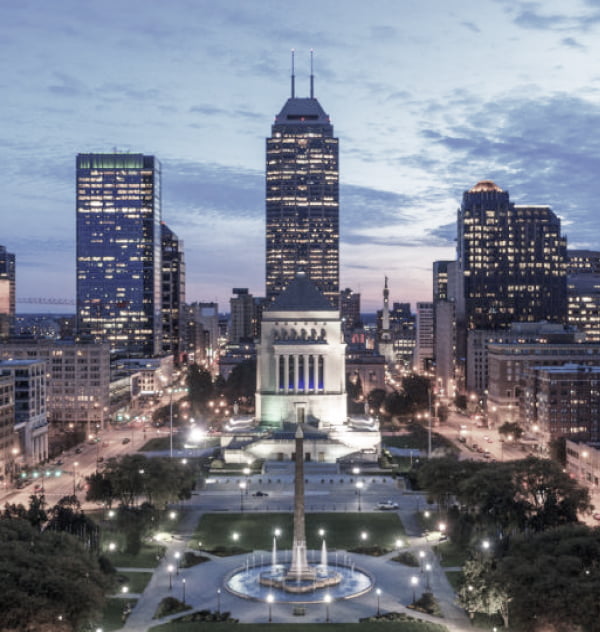
Every year, Indy Chamber hosts a Leadership Exchange trip (affectionately known as LEX) for a group of civic, economic, and community leaders. This year we went to Dublin, Ireland, with a focus on economic development. Delegates immersed themselves in all things Ireland to explore global best practices, engage with local leaders, and study strategies that could help Indianapolis thrive.
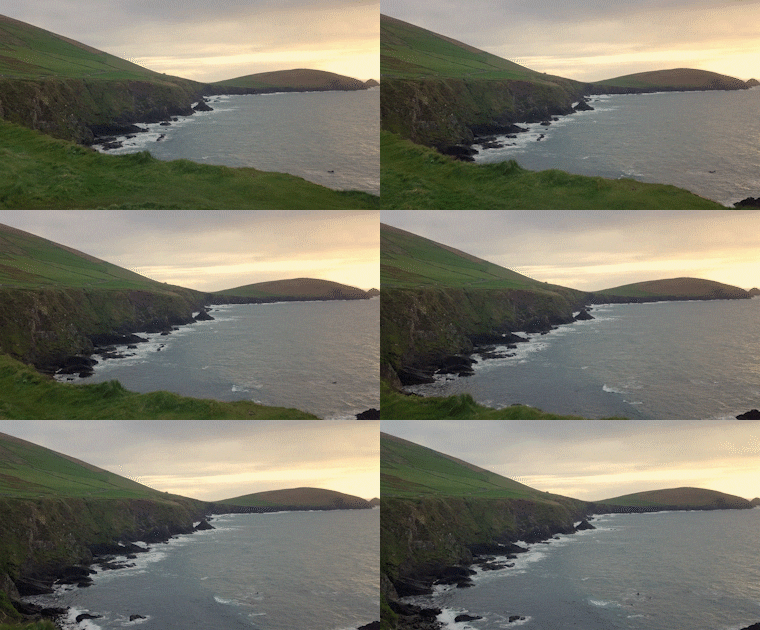
We’re coming back with all kinds of insights. But three lessons especially stand out from Ireland’s trajectory over the past few decades. Today’s update unpacks a few imports we brought home with us from across the pond.
Today’s “craic:”
- Creative Tax Policy Catalyzes Investment
- Talent Development is a Growth Engine
- Global Connectivity is Essential to Scale
- ICYMI: Charting a New Chapter in Downtown West
Creative Tax Policy Catalyzes Investment

A Little Irish History: Don’t worry, we aren’t dialing the clock back to 1014 when High King Brian Boru drove the Vikings out of Ireland. But we are cracking the history books open to the 1950s. That’s when Ireland first opened its economy to international trade and foreign investment, with IDA Ireland as the institution charged with recruiting and expanding foreign direct investment (FDI). As a result, Ireland’s historic agricultural-based economy began shifting toward a knowledge-based economy.
That shift accelerated in the 1990s, when Ireland reduced its corporate tax rate from 40% to 12.5% — phased in over a period of seven years starting in 1996 — as a means of inviting FDI. The low-tax environment unleashed an influx of investment from U.S. and multinational technology and pharmaceutical companies. Other factors, like long-term educational investments, membership in the European Union (EU), and an increased emphasis on attracting FDI, helped grease the wheels further. A once-struggling economy suddenly began to grow its Gross Domestic Product (GDP) by at least 5% annually, leading economic observers to dub the nation the “Celtic Tiger.”
The Dublin Boom: Nowhere was the impact so profound as in Dublin, Ireland’s capital. By 2018, Dublin alone hosted 763 IDA-supported foreign companies employing nearly 100,000 people. Ireland also hosts upwards of 90 pharmaceutical companies employing close to 50,000 people, with many concentrated in and around Dublin. Ireland’s strategy to generate new FDI worked especially well in the life sciences sector, something that’s only accelerated in the years since COVID-19. All told, the country’s goods exports now equal roughly 63% of its GDP.
The Hoosier Application: Indiana is experiencing a similar momentum to Ireland in how our life sciences sector is developing, in an area we see as the city’s future Innovation Development District (IDD). Extraordinary private investment there is being matched by the statewide BioHeartland effort — a $1 billion commitment from the state of Indiana in future tax credits for life sciences sectors.
Downtown Indy already has a remarkable concentration of anchor institutions across life sciences, education, sports, and tourism. The IDD is a way to harness a portion of the increased tax generated by those anchors and reinvest it in infrastructure, development, quality of place, and talent, thereby creating a virtuous cycle where growth helps finance the conditions needed to unlock future rounds of growth.
The details comparative to Ireland’s success are different, but the takeaway remains the same: Creative tax policy can catalyze investment in priority industries and geographies to improve economic conditions and quality of life for Hoosiers.
Talent Development is a Growth Engine
 |
The Talent Gap: Time for another glance through Irish history, this time to the 1960s. At the time, secondary education was rare, often private and expensive. But in 1967, Ireland made secondary education free nationwide and, importantly, guaranteed free transportation to students up through secondary graduation. Before the reforms, less than 60% of Irish 15-year-olds remained in school. Within a decade, secondary education participation rates doubled. Today, Ireland maintains one of the highest rates of secondary education completion in the EU, with upwards of 90% of their youth achieving the equivalent of our high school graduation. That has in turn propelled a massive expansion in the number of youth pursuing post-secondary education. Two data points especially illuminate the story:
Ireland’s postsecondary enrollment increased from 18,500 in 1965 to 278,880 in 2024, a nearly 15x uptick.
Higher education attainment among Irish 25–34-year-olds rose from 31% in 2000 to 63% in 2022.
What played out in Ireland ultimately followed this trajectory: broad investment in education led to rising attainment, which in turn increased specialized workforce capacity, which then enabled Ireland to secure higher-value investment.
The Irish success story isn’t one of simply attracting new corporations and capital investments. They proactively spent generations building the human capital necessary to capture increasingly sophisticated work. And they aren’t slowing down. For example, Research Ireland is currently investing €460 million into nearly 1,400 research positions and PhD programs to bolster their life sciences sector, with much of the investment targeted to their National Institute for Bioprocessing Research and Training (NIBRT). Those life sciences investments of the 21st century were only possible because they rode the coattails of Ireland’s educational transformation of the 1960s.
The Hoosier Application: There are two important applications here for the Indy region. First, we have an opportunity to replicate the kind of targeted investment in talent infrastructure built around industry needs like Ireland did with a new LEAP districting training facility implementing the NIBRT curriculum.
Second, Ireland’s example points to a broader economic development policy question we must answer locally: What might a talent-based attraction and expansion incentive strategy look like alongside the capital incentives we traditionally offer companies? If specialized talent increasingly determines where companies invest, then building, attracting, and retaining that talent must be an explicit part of our economic development toolkit.
Global Connectivity is Essential to Scale

At the “Crossroads:” There’s one more piece to the Irish puzzle: global connectivity. Indeed, Ireland was able to support such dramatic growth in the 1990s up through the present because it became deeply connected to global markets. Dublin’s world-class airport and vibrant port, Ireland’s export orientation, and the country’s access to international markets weren’t secondary benefits of a long-term growth strategy. They were prerequisites for it.
Indianapolis has similarly positive economic indicators. We’ve long been known as the “Crossroads of America” for good reason. We’re growing faster than the nation on average, with 12.5% real GDP growth and a population increase of over 100,000 in the past six years. But we’re still flying under the radar based on Resonance’s 2025 City Index. They ranked Indianapolis #53 among U.S. cities, behind peers like St. Louis and Columbus. And we are historically connected to the world, with 57 nonstop flights via IND. Closing the gap between performance and perception is an economic imperative if we want to take the next step.
Taking to the Sky: Just like Dublin, we need to become more globally-connected. To do so, Indy Chamber and the Indianapolis Airport Authority are launching the Speed City Nonstop Growth Fund — a $15 million, private-sector-backed fund meant to add more nonstop domestic and international flights to and from Indianapolis International Airport. This type of fund is a proven model that incentivizes new service to priority markets, strengthens airline partnerships, and protects connectivity when global events, economic uncertainty, or industry headwinds threaten existing routes.
For businesses, such a fund will mean more connection to national and international customers, capital, suppliers, talent, and markets. For the region, we’ll be able to attract the very best sporting events and conventions. Residents stand to benefit, too. More nonstop flights from an already best-in-class airport means fewer layovers, better travel experiences, and more access to the world.
Lift Off: Why pursue lift off now? Because demand exists as demonstrated by, coincidentally enough, Dublin. In 2025, Aer Lingus added nonstop service from Indianapolis to Dublin four times per week. Overwhelming demand led Aer Lingus to expand to five flights per week in less than a year. This fund also comes at a critical time because other cities aren’t waiting. When St. Louis partnered with British Airways in April 2026 to launch nonstop service to London, projections indicated it would generate up to $100 million in annual economic impact. That’s the competitive reality we’re up against.
Here’s What We’re Thinking
The views below are expressed in the voices of our advocacy team members, but they align with the Chamber’s broad position on each topic.
Ireland’s Lessons Offer Key Questions to Accelerate Next Wave of Hoosier Progress
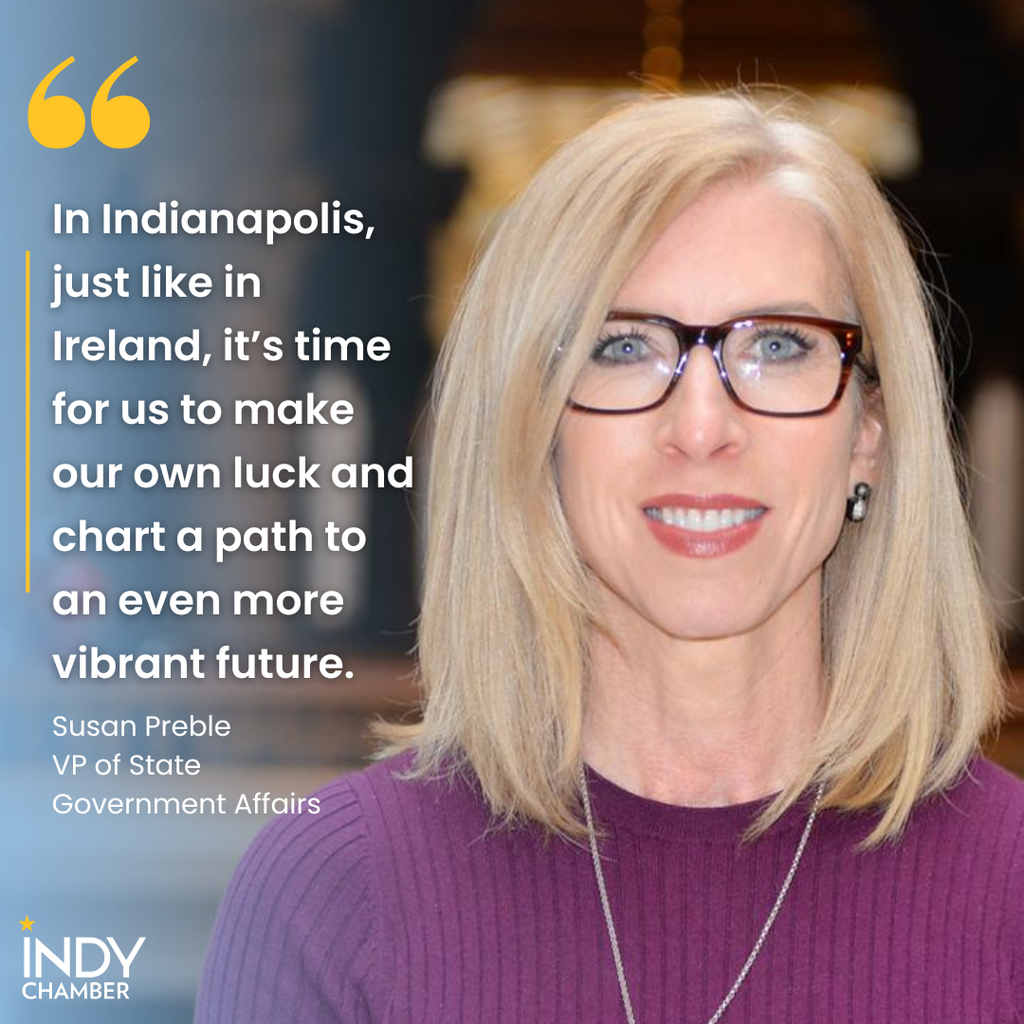
Our time in Ireland was phenomenal — from the vibrant culture to incredible food to unmatched sightseeing. But even more, I came away from our time with local leaders struck by the example they set for us in Indiana. The three lessons captured above give rise to important questions that sit at the heart of where our region goes next.
How can Indiana leverage tax policy to do more than attract individual projects and catalyze a self-reinforcing cycle of investment and reinvestment?
How can we move from attracting companies to anticipating and producing the talent those companies need to make Indiana their long-term home?
What will it take for Indianapolis to make global connectivity into a durable, competitive advantage?
We are well on our way to answering some of these questions. On others, we have some way to go. But if we can make collective progress on all three, I’m confident in our ability to make Central Indiana even stronger than it is today.
Lifting our profile as a global hub and world-class region won’t happen through luck. After all, Ireland made their own luck through careful planning, thoughtful strategy, and a little creativity. It’s time for us to do the same.
ICYMI: News and Opinion
Indy Chamber President and CEO Matt Mindrum co-authored an op-ed in Indianapolis Business Journal with Indianapolis International Airport Executive Director and CEO Mario Rodriguez and civic leader David Lewis to explain why this fund can help us continue to compete with and outperform peer markets.
An Indy Chamber-led coalition laid out its vision for reimagining Downtown’s West Street as a pedestrian-friendly innovation district connecting the myriad economic, educational, and cultural assets along the west side of Downtown. Read the IBJ article featuring Indy Chamber’s Matt Mindrum, or listen to the podcast on your Friday commute.
Thanks for reading!
Follow the Indy Chamber’s advocacy efforts, now year-round and beyond the legislative session with our monthly Legislative Updates. We’ll share timely insights, policy progress and advocacy priorities.