August was a hard month. No sooner had students gone back to school than a series of devastating storms hit our state — from wind damage and weeks-long power outages in Gary to historic flooding across Central and Eastern Indiana. So today’s update is a little different, starting with a list of resources for those in need and ways to give back to support your fellow Hoosiers. After that, we look at what Indiana can do to safeguard our communities and our economy from future disasters.
Today’s Update:
- On the Ground: Flood Response and Support
- ICYMI: News and Opinion
On the Ground: Flood Response and Support
Catch Up Quickly: Central and Eastern Indiana experienced severe flooding in August while the northwestern part of the state was impacted by storms that brought damaging winds and prolonged power outages. Some areas saw nearly a foot of rain over a couple of days. The White River crested at a record of 24.6 feet. Meteorologists estimated the impact on Marion and Hamilton Counties as a one-in-100-year event while places like Muncie, Newcastle, and Cambridge City experienced a one-in-1,000-year event. Numerous roads and bridges were washed out. Hundreds of Hoosiers were evacuated. And thousands of homes and businesses were irreparably damaged. Now begins a long recovery.
How You Can Find Help (Or Lend Aid): We’ve rounded up a few resources below that you can share with those in need alongside opportunities to support your fellow Hoosiers.
- Hoosier Storm Recovery Resources from the State of Indiana
- Flood Resources from City of Indianapolis
- Indianapolis Flood Relief Resources from Mirror Indy
- Options to Support Recent Indiana Natural Disasters from Central Indiana Community Foundation
- How to Find and Give Flood Relief in Indiana from WISH-TV
Hotter Days, More Rain: While August’s weather was historic and, in some ways, unprecedented, disasters like the recent floods and storms may become more common in the years ahead as climate change impacts become ever more prominent. Back in 2018, Purdue University led the creation of an Indiana Climate Change Impacts Assessment, which analyzed how climate change was already impacting the Hoosier state then and how it might impact us moving ahead. Mirror Indy conducted a deep-dive interview with one of the analysts behind the project. In addition to hotter average temperatures, their reporting showed Indiana is already experiencing increased rainfall compared to previous centuries. But the issue isn’t just quantity. It’s that, rather than steady rainfall spread throughout a particular year, we’ve entered into a growing pattern of droughts followed by intense periods of heavy rainfall. This past July and August across much of the state exemplified this new normal.
The Impact of Wetland Loss: Part of why increased rainfall is such a danger to Indiana communities has to do with wetland loss. Historically, wetlands covered much of Indiana. But according to Audubon Great Lakes, our state ranks fourth among states with the biggest loss of wetlands. This has been due to agriculture, logging, community growth, and other types of development. That brings a host of issues, one of the most serious being increased flood risk, given wetlands’ capacity to store floodwater. While Indiana has some wetland protections in place, state lawmakers have reduced them multiple times in the past five years. Meanwhile, our statewide wetlands protection program was found to be out of compliance by the federal government, with over $100 million collected in wetlands payments since 2018 but only two projects completed as dozens of other projects sit in limbo.
Tipton’s Warning: Tipton, a small town of just over 5,000 people north of Indianapolis, offers a cautionary tale. The community sits within the Cicero Creek Watershed. As of 2024, the watershed and the surrounding area had lost over 95% of its wetlands due to them being drained or filled upstream. That amounts to an approximate loss of 2 billion gallons of water storage potential. Severe flooding thus became more likely, turning into reality once back in 2013 and again this August, which saw the forced evacuation of a mobile home community. As Audubon Great Lakes noted, “Losing water holding capacity upstream will result in uncontrollable water downstream. Preserving wetlands are essential to keep communities safe from unpredictable flooding events.”
Why It All Matters: Natural disasters are devastating for the people and communities directly impacted. It’s important to center the deeply human impact of these events. At the same time, an increased frequency and severity of damaging weather events is bad for business. When the American Economic Association analyzed a landmark paper in the American Economic Journal: Macroeconomics, they found severe weather events:
- Lowered industrial production growth;
- Increased unemployment rates; and
- Raised inflation, especially through food and energy prices.
Meanwhile, CDP — a global nonprofit focused on helping companies manage environmental impacts — noted in a May 2026 press release that “although the price tag of environmental risks is very high, the cost of mitigating them is much lower.” Thus, it’s imperative that we safeguard Indianapolis and other communities across the Hoosier state against the worst of future weather.
Protecting Against Future Disasters: According to ClimateCheck, the two biggest risks facing Indianapolis amid a changing climate are severe flooding and extreme heat. Mitigating the impact of future rainfall events involves restoring and protecting our remaining wetlands, upgrading wastewater systems, and enforcing floodplain rules that limit certain kinds of development in especially flood-prone areas. Meanwhile, we can better counter extreme heat by increasing available green space and planting trees to combat the urban heat island effect, given over a quarter of the land in downtown Indianapolis is surface parking lots.
In addition, there are two things every individual can do now to protect themselves. 1) Maintain a home emergency kit in case of severe weather; and 2) Ensure your property is covered by adequate flood insurance. The city of Indianapolis is part of the National Flood Insurance Program, which guarantees the availability of flood insurance to all residents. Learn more at Floodsmart.gov.
Here’s What We’re Thinking
The views below are expressed in the voices of our advocacy team members, but they align with the Chamber’s broad position on each topic.
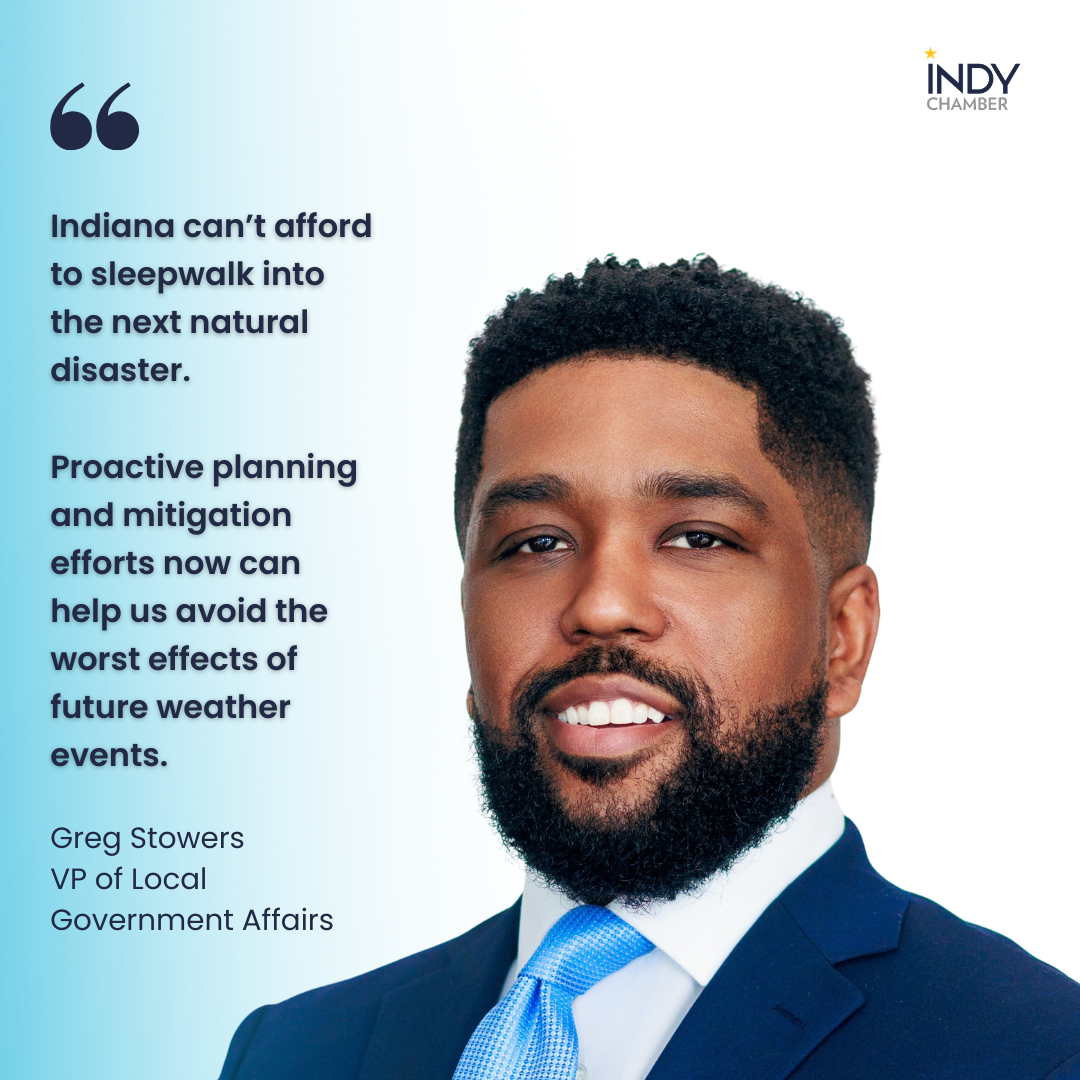
Hoosiers are hardworking, resilient people — always ready to lend a hand to neighbors and strangers alike when disaster strikes. Indeed, it’s easy to find inspiring stories of everyday people stepping up to help one another through the recent storms and flooding that impacted practically every corner of the state. But Hoosier character alone can’t stop the next disaster. Recent storms illuminated the many ways our built environment and infrastructure isn’t prepared for a kind of flooding that’s only going to become more common in the years ahead.
Harrowing pictures of roads washed away, bridges collapsed, and houses fully underwater have captured our attention for good reason. Meanwhile, thousands of residents in Northwest Indiana went without power for weeks in late August after storms rolled through. It’s easy to think this was all a random act of Mother Nature. Perhaps some of them were inevitable. But this outcome was in part down to past human decisions and policy choices across the state.
Preparing for the next disaster doesn’t start the moment the rain comes and the rivers rise. It must start now — with local, state, and community leaders stepping up to safeguard Indiana against future disasters. I’m confident we’ll step up to help each other rebuild in the hard days ahead. But nothing beats rebuilding like never having to rebuild in the first place. So, as we rebuild this time, we must also work to restore critical wetlands and invest in flood-prevention infrastructure.
ICYMI: News and Opinion
Indy Chamber President and CEO Matt Mindrum co-authored an op-ed in Indianapolis Business Journal with Indianapolis International Airport Executive Director and CEO Mario Rodriguez and civic leader David Lewis to explain why this fund can help us continue to compete with and outperform peer markets.
In a recent Indianapolis Recorder op-ed, our vice president of local government affairs, Greg Stowers, writes that issues like government budgeting rarely capture our interest in the competition for attention, but they’re important to watch as they affect us all on a human level.
Thanks for reading! Follow the Indy Chamber’s advocacy efforts, now year-round and beyond the legislative session with our monthly Legislative Updates. We’ll share timely insights, policy progress and advocacy priorities.