Crank up the AC. Turn on those ceiling fans. And make some iced tea. Because heatwaves aren’t the only thing raising the temperature in the Hoosier state. Even as this November’s elections remain a blip on the horizon, the Secretary of State race is already hotter than the heat dome that gripped Central Indiana earlier this month.
While the Secretary of State’s impact on businesses and economic development is largely administrative, it matters for creating a healthy economic landscape. This month’s update will get you up to speed on why this elected office matters, who’s vying for the position, and how you can be an informed voter well in advance of casting your ballot come November. (Sidenote: If you want to dive even deeper on this topic, register for HobNob next month.)
In this update, we’ll also cover the latest on two proposed taxes for Indianapolis residents coming down the pike: the Indianapolis Public Education Corporation’s proposed operating referendum and the City-County Council’s updated “wheel tax.”
Today’s Itinerary:
- Indiana Secretary of State Race
- Here’s What We’re Thinking
- Taxes Incoming
- ICYMI: News and Opinion
Indiana Secretary of State Race
Catch Up Quickly: Indiana’s Secretary of State position is one of five statewide elected offices. The seat doesn’t always draw much attention when it comes up for reelection. But this year is different. Four candidates are vying for the position, with competing visions for the office. And given that incumbent Diego Morales didn’t receive the Republican nomination at his party’s state convention in June, there’s guaranteed to be a new face in the role come January.
What’s a Secretary of State Do? We’ll get to the choices facing Hoosiers in a moment. But first, a primer on what this role is in charge of. The Secretary of State is Indiana’s chief election officer, meaning they oversee statewide elections, process candidate filings, and certify election results. They also act as the chair of the State Recount Commission, which oversees cases where an election result needs to undergo a recount.
But their duties aren’t restricted to just administering elections. While they don’t directly impact economic development in the way the Indiana Secretary of Commerce (an appointed position) or the Indiana Economic Development Corporation do, the Secretary of State plays multiple important functions for businesses and corporations in Indiana. For example, they register new businesses and maintain official records; regulate securities, including investigating potential investment fraud; and license vehicle dealerships. While current Secretary of State Diego Morales did undertake an economic development trip to India in 2025, the act was outside the office’s typical duties and drew bipartisan criticism from other elected officials.
The Hottest Race in Town: Four candidates are on the ballot this fall. While Republicans haven’t lost a race for statewide office since 2014, this year’s path is less straightforward in a crowded field that features a former Republican Mayor of Indianapolis who is running as an independent.
- Max Engling won the Republican nomination at the GOP’s state convention. He beat out Knox County Clerk David Shelton and current Secretary of State Diego Morales. Engling, a staffer for U.S. Senator Jim Banks, was a last-minute addition to the slate of candidates. A number of high-profile political figures pulled their endorsements of Morales following a series of controversies over his conduct while in office. Engling has stated one of his primary objectives is to create closed primaries, which restricts primary voting to only those registered with a specific party. So registered Republican voters can only vote in Republican primaries and registered Democrat voters can only vote in Democratic primaries.
- Beau Bayh, the son of former Indiana Governor and U.S. Senator Evan Bayh, defeated Blythe Potter at the Indiana Democratic Convention to assume his party’s nomination. If elected, he has pledged to conduct an independent audit of the Secretary of State’s office, expand voter participation, and safeguard election security.
- Lauri Shillings is the Libertarian Party candidate. Shillings lives in Carmel, has acted as the party’s Hamilton County chair since 2021, and previously ran for a state congressional seat in 2024. According to her campaign website, Shillings’ priorities include protecting election integrity and privacy, supporting small businesses, and improving voter education.
- Greg Ballard, formerly the Republican Mayor of Indianapolis, is running as an independent under the banner of the “Lincoln Party.” Ballard needed at least 37,000 verified signatures to be on the ballot. His campaign submitted over 74,000 signatures by the June 30 deadline. To gain automatic ballot access for the newly formed Lincoln Party, Ballard will need to receive at least 2% of the vote in November. Ballard’s campaign website indicates that he intends to safeguard Indiana’s elections and create Indiana’s first statewide voter guide.
Here’s What We’re Thinking
The views below are expressed in the voices of our advocacy team members, but they align with the Chamber’s broad position on each topic.
Hoosiers Need to Be Able to Trust Who Oversees Elections
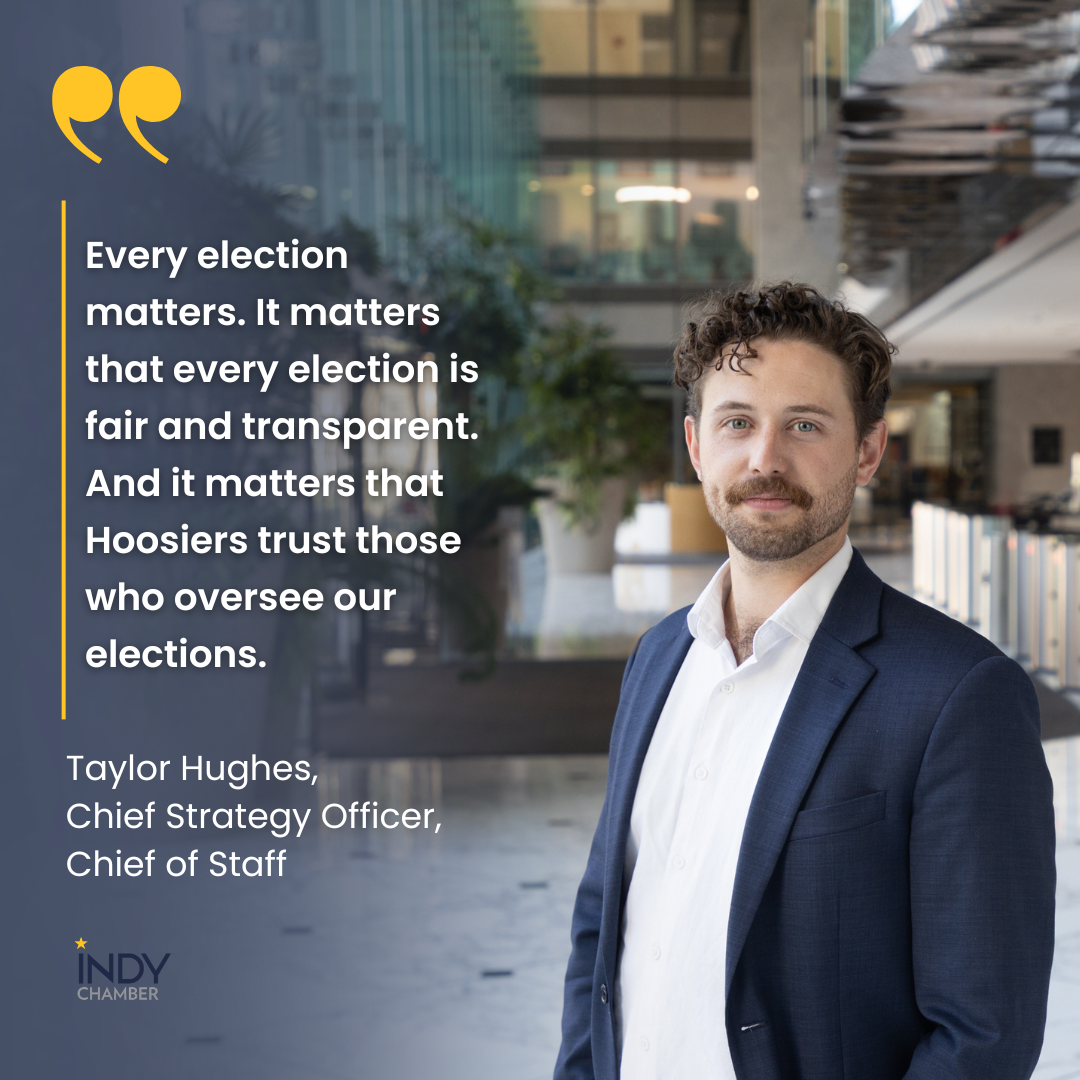
Elections, both local and statewide, can dramatically impact everything from taxes to energy and infrastructure policy to workforce development. Our Secretary of State isn’t directly involved in setting any of those policies or making direct decisions in those areas. But those decisions reside downstream from elections. And Hoosiers — from individual citizens to small business owners to the CEOs of Indiana’s biggest corporations — want those decisions and policies made in the context of fair and transparent elections.
To that end, it matters whether Hoosiers trust that our Secretary of State is a neutral arbiter when it comes to conducting elections and carrying out other responsibilities of the office, like investigating fraud and ensuring businesses are given a fair playing field to operate on. Once elected, the Secretary of State must work on behalf of all Hoosiers, not for personal gain or an individual political party.
Recent years have eroded that trust. There’s an opportunity for whoever next assumes the role to rebuild it, regardless of their political party label.
Taxes Incoming
Indianapolis residents may be faced with higher tax bills come 2027 due to two new proposals: one meant to create sustainability and stability in our public education system, the other geared toward fixing our crumbling roads and infrastructure. While we don’t take any tax increases lightly, especially at a time when affordability concerns remain high, we believe each is necessary to ensure Indianapolis remains a world-class city.
- Indianapolis School Referendum: At their June 22 meeting, the Indianapolis Public Education Corporation (IPEC) voted unanimously to put a $0.37 operating referendum on November’s ballot to support Indianapolis Public Schools (IPS) and public charter schools within IPS boundaries. That would mark an increase from the current $0.19 referendum that homeowners within IPS boundaries pay. Homeowners with a property value of $150,000 — the median value of homes within IPS boundaries — would pay about $220 dollars annually if the new referendum passes, an increase of about $105 per year from what homeowners pay under the current referendum.
The new referendum would generate about $88 million, split between IPS and approximately 60 local charter schools that have signed up to participate in the referendum. Funds are expected to support better services for students with disabilities and English language learners, alongside other student programming and teacher and staff pay.
Given IPS’ looming $40 million budget deficit, even with this referendum, they will need to make an additional $20 million in cuts to their operating budget. That’s on top of the $24 million in cuts they announced earlier this spring. We see this referendum as a necessary, time-bound lifeline for our public-school systems to find stability. In our statement supporting the proposed referendum, we noted, “Strong public schools are critical for families, the workforce, and the long-term competitiveness of the Indy region. A failure to secure sustainable operating support would create instability as we are seeking to build a more coordinated and effective public education system.”
Also in IPEC news, Mayor Joe Hogsett selected, and the corporation unanimously approved its first executive director at their July 22. Karega Rausch is currently the president and CEO of the National Association of Charter School Authorizers, which advocates for charter best practices and quality nationally. He previously served as education and charter schools director for the Indianapolis Mayor’s Office, director of Stand for Children’s Indianapolis affiliate, and chair of the Indiana Charter School Board. He holds a Ph.D. in educational psychology from Indiana University. - Wheel Tax: In our June update, we covered a proposal from the Indianapolis City-County Council to implement a “wheel tax” on Indianapolis residents. The council, by a 14-10 vote, advanced Proposal 192 earlier this month. Currently, Marion County residents pay anywhere from $10 to $50 dollars in vehicle registration fees annually, depending on the type of vehicle. Proposal 192 implements a flat $240 wheel tax for large vehicles — like semitrailers, buses, and tractors — and a flat $100 tax for standard vehicles, including cars, trucks, and motorcycles. From 2027 to 2031, the plan is expected to raise $855 million in new revenue to fix roads and infrastructure. What’s more, implementing the tax ensures Marion County raises enough new revenue so as to receive a yearly state “match” of $50 million. For more on why Indy Chamber supports the proposal, see president and CEO Matt Mindrum’s op-ed in the Indianapolis Business Journal. Mayor Hogsett vetoed Proposal 192 on July 16. Council President Maggie Lewis announced that the Council will reconsider the proposal and vote to override the veto at the Aug. 10 full council meeting, which coincides with the introduction of the proposed 2027 City-County Budget. Whew, it’s getting hot in here.
ICYMI: News and Opinion
Public safety is the essential lifeblood of our city and ultimately must be centered around the human beings most affected, writes Indy Chamber’s Vice President of Local Government Affairs Greg Stowers in the Indianapolis Recorder.
Indianapolis should continue to embrace growth, and that requires welcoming investment and embracing opportunity. The City-County Council’s proposed data center moratorium stands at odds with that goal by sending a message that Indy is closed for business, writes Indy Chamber president and CEO Matt Mindrum in the Indianapolis Business Journal.
Thanks for reading!
Follow the Indy Chamber’s advocacy efforts, now year-round and beyond the legislative session with our monthly Legislative Updates. We’ll share timely insights, policy progress and advocacy priorities.