
It’s late June in Indiana, and summer is in full swing. Time to pop on your sunglasses, hit the road, and feel the breeze in your hair. Just watch out for those potholes! In Indianapolis, daily commutes and family outings can feel like navigating an asphalt obstacle course.
But have no fear, committed reader: local roads may be in for a much-needed makeover. So stay in the driver’s seat and fire up Google Maps as the rubber meets the road with our main topic this month: Road Funding.
We’ll also cover other important legislation that goes into effect this summer.
Today’s Itinerary:
- Policy Updates: Road Funding
- Here’s What We’re Thinking
- Key Legislation Taking Effect
- ICYMI: Road Funding Op-Ed
Road Service Funding
Catch Up Quickly: Indiana comes by its moniker “the Crossroads of America” honestly. We’re consistently ranked as having some of the best road conditions in the United States, coming in at #3 according to a 2026 study from Construction Coverage that analyzes data from the U.S. Department of Transportation Federal Highway Administration. But there’s a major pothole in these crossroads: Indianapolis.
Based on the most recent asset management report from the Indianapolis Metropolitan Planning Organization, over half of Indianapolis’ streets are rated “poor.” A quarter are rated as “fair,” and just a fifth earn a “good” rating. The city has tried to make progress in recent years, but the issues far outstrip annual funding. In fact, the Indianapolis Department of Public Works estimated in 2022 it would take over $1 billion annually to build up and maintain transportation infrastructure — which includes bridges and sidewalks alongside roads. That’s nearly the entire city budget in a given year. So, even as the city has tried to squeeze every last dollar to repair and improve our roads in recent years, it’s mostly felt like band-aids on gaping asphalt wounds.
The Wrench in the Gear Shaft: Before we look at a potential solution proposed by the Indianapolis City-County Council, let’s put the car in reverse for a moment. Indianapolis’ roads don’t exist in a vacuum. They exist in, well, Indiana. And the way our state apportions road funding to support different municipalities has left Indianapolis playing catch-up.
State road funding formulas tend to disadvantage urban areas. That’s because the state formula distributes funding based on center-line miles instead of total lanes. Here’s what that means in practice. Consider a five-mile stretch of Keystone Avenue, one of Indy’s busiest thoroughfares. It has six lanes running north-south through the heart of the city. Contrast that with a five-mile stretch of a one-lane road in Ohio County, the least populated county in the state. Under our state funding formula, a five-mile stretch of that one-lane road receives the same amount of funding as an equivalent length of Keystone Avenue, despite the mismatch in vehicle usage and actual square footage of asphalt.
If you divide the funding pool by vehicle traffic, that means Ohio County gets something like $20 per vehicle mile. Marion County? Just over $3, putting Marion County last among our 92 counties statewide.
Something New Under the Hood: Recent legislative sessions have been busier than southbound Meridian Street during the morning commute. And they’ve produced multiple bills directly targeted at road service funding in hopes of correcting these disparities.
In 2025, HEA 1461 brought major changes to road funding distribution. One of the biggest was its new provisions for the Community Crossings Matching Grant, which specified that $100 million of the initial $200 million in the fund would only support communities with wheel or vehicle excise taxes. What’s more, starting in fiscal year 2027, Indianapolis becomes eligible for $50 million in road funding above the $200 million fund. But only if Indianapolis matches those funds with local tax dollars to the tune of $50 million in 2027, $70 million in 2028, $80 million in 2029, $90 million in 2030, and $100 million annually in 2031 and beyond.
Then in 2026, SEA 179 added a few more suitcases to the trunk. First, it increased the ceiling for wheel and vehicle excise taxes for counties with approved asset management plans. Second, the bill tied any county-level wheel tax increase to also needing an approved vehicle excise tax. Third, the bill clarified that any road projects supported by state funds must go through the approved INDOT planning process.
Time for an Oil Change? We took the scenic route, but we’re almost at our destination. Namely, what’s being done in Indianapolis? The Indianapolis City-County Council introduced a proposal to increase two annual vehicle taxes—both a wheel tax and a vehicle excise tax — which haven’t increased since the 1990s. Here are the basics of the proposal:
- The wheel tax applies to larger vehicles — think heavy trucks, semi-trailers, and recreational vehicles — and would increase to a flat $240 fee. Right now, the fee is anywhere between $10 and $40 based on vehicle type.
- The vehicle excise tax applies to all passenger vehicles. It’s part of what you pay when you register a vehicle with the BMV or renew your registration. The average fee right now stands at approximately $20. This proposal raises that to a flat $100 annual fee.
The plan was introduced at the June 1 council meeting and could be passed as soon as July 6. If passed, it would take effect starting January 1, 2027, and generate an estimated $355 million in new tax revenue over five years. That’s a dramatic increase from the roughly $15 million annually these two taxes currently bring in for Marion County.
When you pair those new funds with the state’s matching grant funds, an additional $145 million would be added to the city’s budget for road service in 2027 alone. Talk about shifting into high gear, considering the entire 2026 budget to support roads, bridges, and greenways was $216 million. Adding $145 million on top of that $216 would represent a 67% increase in annual funding.
All told, the plan projects as much as $855 million in new dollars generated to fix Indianapolis roads. That may fall short of the $1 billion annual number quoted by the Indianapolis Department of Public Works. But it would represent a major boost nonetheless.
A Speeding Ticket for the Council? The proposal from the City-County Council has so far drawn one key detractor: Mayor Joe Hogsett. He came out strongly against the plan, viewing it as an untenable “financial burden” for Indianapolis taxpayers. While Hogsett could veto this council ordinance — assuming it passes — the plan carries widespread support among Democratic Council members and a two-thirds majority can override a mayoral veto.
Here’s What We’re Thinking
The views below are expressed in the voices of our advocacy team members, but they align with the Chamber’s broad position on each topic.
Enough Patchwork Solutions — We Need Comprehensive Infrastructure Upgrades
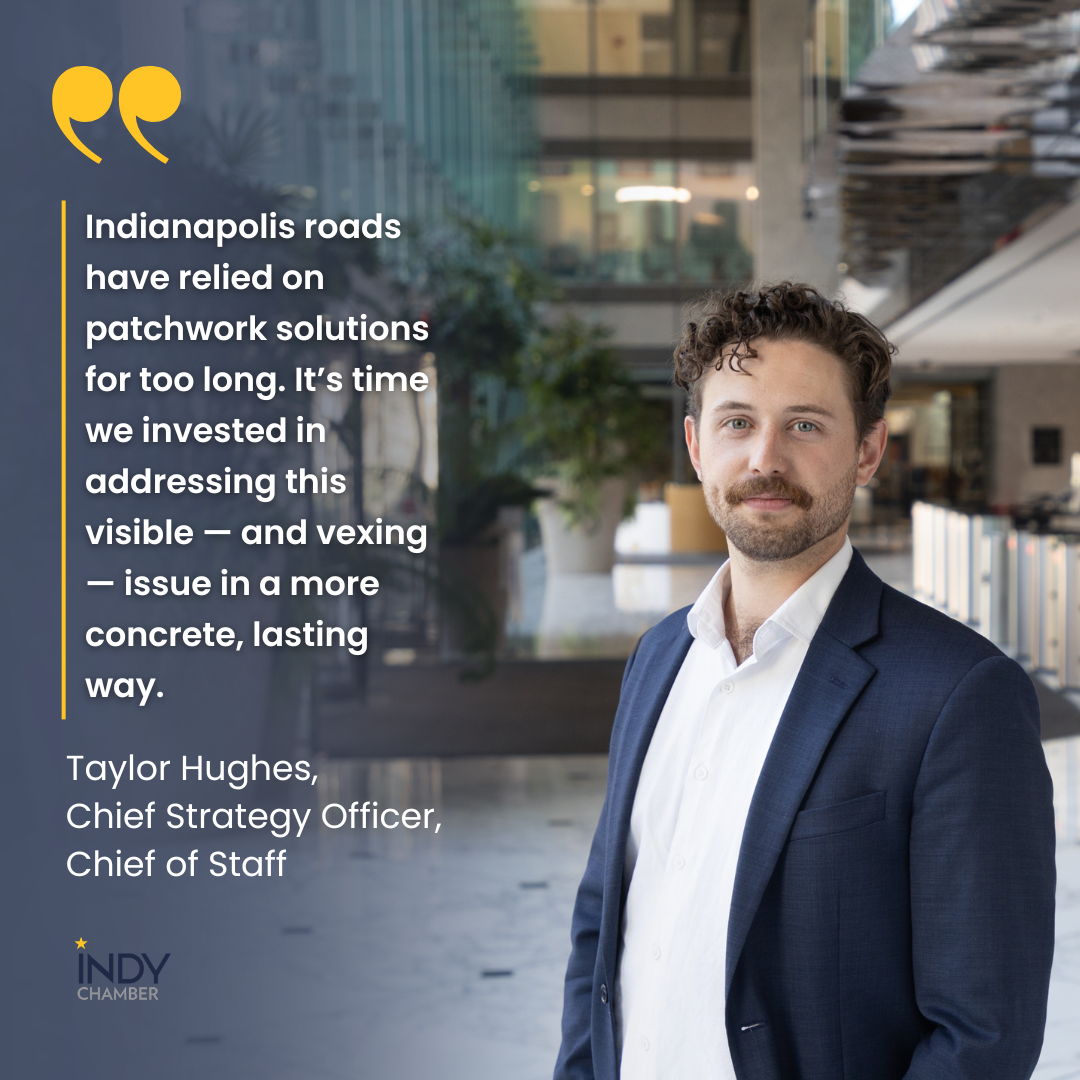
Infrastructure problems in Indianapolis are an old problem. For too long, we’ve tried to tackle them with fixes around the margins. It’s time we took a different approach. That’s why we applaud the City-County Council for advancing a serious plan to address this longstanding issue. Not only does their proposal generate much-needed revenue, it leverages $50 million in matching state dollars that will otherwise pass us by. Importantly, commercial vehicles bear the brunt of the tax increase as they’ll pay almost double what an individual will pay for their car or SUV. This makes sense, because commercial vehicles have a greater impact on our roads.
Of course, no one likes raising taxes. You’ve heard us consistently argue that any public investment needs to be balanced with fiscal discipline and an eye toward how much Indianapolis households can bear at a time of deep economic strain. Road quality is an issue that affects the vast majority of Indianapolis residents and businesses. Every pothole fixed is one less opportunity for an expensive car repair. We must face reality. Our roads can’t repave themselves. It’s not just that they are bad now. They will only get worse without intervention, sooner rather than later.
The quality of our streets and sidewalks sends a message. Right now, the message isn’t a good one. As a city, we can’t ignore this issue any longer. If we want to remain one of the best places to live in the country, it’s time we moved from patchwork fixes to long-term solutions. This proposal can make the road to that future a lot less rocky.
Pitstop: Key Legislation Taking Effect
Pump the brakes! Road funding isn’t the only excitement you can expect in this month’s update. Pull over for a few roadside attractions as we take a brief look at different legislation from the 2026 session that goes into effect on July 1.
- Housing Development Updates: HEA 1001 looks to increase housing supply by reducing barriers at the local level and improving transparency. Among many changes, two are especially worth highlighting. 1) Starting in 2027, it requires annual housing reporting on permitting activity, approvals/denials, new units, and how long approvals take. 2) Local governments must hold a public hearing by January 1, 2027, to review development rules with an eye toward increasing housing stock. The legislation is a pragmatic step to a more competitive Indiana housing market.
- Childcare and Work-Based Learning Access: HEA 1177 positioned childcare as workforce infrastructure by incentivizing employers to provide employees with improved childcare access. Meanwhile, HEA 1098 aims to help employers participate in work-based learning and apprenticeship programs.
- Tax Cleanup: HEA 1210 represented a technical yet important tax cleanup bill, in large part meant to allow local governments to better respond to changes brought about by SEA 1’s property tax changes. For example, the bill delays local income tax changes passed through SEA 1 in 2025 from going into effect until 2029, rather than 2028. It also implements a backstop in case local governments fail to renew their local income tax rate, setting a default minimum that covers a local municipality’s debt service.
- Immigration Enforcement: SEA 76 requires schools, hospitals, and local law enforcement agencies to comply with federal immigration officials and makes it unlawful to knowingly recruit, hire, or continue employing unauthorized immigrants. The Attorney General was also given the power to bring legal action against employers who are suspected of employing unauthorized immigrants, though the bill included protections for employers who can show they attempted to verify employee eligibility by using the federal E-Verify program.
ICYMI: News and Opinion
Indianapolis Business Journal: Fixing Indy’s roads will require real investment, coupled with leadership and accountability, writes Indy Chamber’s president and CEO Matt Mindrum.
Thanks for reading!
Follow the Indy Chamber’s advocacy efforts, now year-round and beyond the legislative session with our monthly Legislative Updates. We’ll share timely insights, policy progress and advocacy priorities.